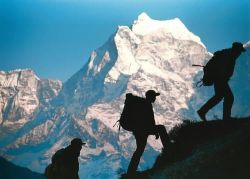
Trekking Tours

Posted by Author On 5/29/2009

POST-SUMMARY-HERE

Everest, Everest History, Everest Firsts

Posted by Author On 5/29/2009

POST-SUMMARY-HERE

Expedition, expedition list, expeditions on 8000m peaks

Posted by Author On 5/29/2009

POST-SUMMARY-HERE

Ed Viesturs the famous American climber.

Posted by himalman On 7/31/2009 02:39:00 pm 1 comments

Birthdate: 6/22/59
Specs: 5-foot-10, 165 poundsEd Viesturs
Home: Bainbridge Island, Washington
Full Bio: Click here to view

Ed Viesturs is America’s leading high altitude mountaineer, having climbed many of the world’s most challenging summits, including ascending Mount Everest seven times. He recently completed a 16-year quest to climb all 14 of the world’s highest mountains (above 8,000 meters) without the use of supplemental oxygen. In doing so, he became the first American and the 5th person in the world to accomplish this. He reached the summit of his 14th peak, Annapurna, on May 12, 2005. This May, he summited Everest for the 7th time.

“When I first attempt a Himalayan peak,” Viesturs explains, “I climb without bottled oxygen, even if it keeps me from reaching the summit. My personal goal is to see how I can perform, to experience the mountain as it is without reducing it to my level. For me, how I reach the top is more important than whether I do.


“I’m aware of the tricks that altitude and hypoxia can play on you. While climbing, I test myself, asking myself whether I’m aware of the conditions, of my actions, and of what is around me.”


“Once climbers are on oxygen,” Viesturs continues, “they become stronger. But it’s a bit of a crutch. Without it, I don’t have a mechanical apparatus that can fail on me and thereby endanger me. The oxygen system is awkward. Sunglasses won’t fit over the mask, so I have to wear goggles, which fog up. Also, I can’t seem to suck enough air fast enough through the valves of the mask — I have to rip it off to take a full breath.
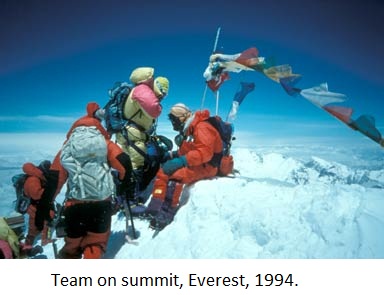
“Most importantly, I’m aware of the tricks that altitude and hypoxia can play on you. While climbing, I test myself, asking myself whether I’m aware of the conditions, of my actions, and of what is around me. Exhaustion and hypoxia can cause one to lose it mentally, and I never allow myself to fall into this state. When I’m guiding, however, I always use oxygen. You’re there for the clients, and oxygen does enable you to function better, both physically and mentally.” Ed Viesturs on summit, Everest, 1994.
Viesturs was born in 1959 and grew up in the flatlands of Rockford, Illinois, where the highest objects on the horizon were water towers. His parents were immigrants – his father, a mechanical design engineer from Latvia; his mother from Germany – who arrived in the early 1950s. In high school, Viesturs read and was captivated by Annapurna, the French climber Maurice Herzog’s famous and grisly account of the first ascent of an 8,000-meter peak in 1950. I reminded Viesturs that Herzog’s tale had a lot more frostbite, amputation, and near-death suffering than it did fun. “That’s not what interested me,” he replied.
“What I liked was that these guys had a goal and they just wouldn’t give up. They spent months and months finding the mountain; then they climbed it. So simple, so basic. I’m a very goal-oriented person, and I like things that take a long time to accomplish.” Viesturs on the summit of Mansulu, 1999.

After some beginner’s rock climbing at Devil’s Lake, Wisconsin, Viesturs left the Midwest for the University of Washington in 1977 and inaugurated a long-running obsession with Mount Rainier. “I could see it from my dorm window, and it became my focus,” he says. “I was maniacal about it. Every weekend, I’d bum a ride or hitchhike, rain or shine, just to be on the mountain.”
He eventually landed a job as a guide with Rainier Mountaineering Inc., then began a four-year period combining veterinary studies at Washington State University in Pullman and guiding during the summer. After becoming a vet in 1987, Viesturs practiced in two clinics run by friends who reluctantly gave him months off at a time to climb in the Himalayas. Finally, his absences were too long and too frequent, and he was forced to choose: be a vet or be a climber. He chose the mountains.

* Source : – Ed Viesturs homepage

* zobacz : Album - Zdobywanie Mt. Everst


goryonline.com


* zapraszam do subskrypcji mojego bloga :

AddThis Feed Button

** zapraszam na relacje z wypraw polskich himalaistów.

The Elizabeth Hawley Story - I’LL CALL YOU IN KATHMANDU.

Posted by himalman On 7/24/2009 08:05:00 am 0 comments

I’LL CALL YOU IN KATHMANDU
The Elizabeth Hawley Story

She defied the conventions of her era: an American women on her own in Nepal for more than four decades, celebrated as the unofficial chronicler of Himalayan expedition climbing.

Elizabeth Hawley Biography

• Based on extensive interviews with Hawley, celebrated mountaineers, and Kathmandu intimates, and full access to Hawley’s meticulous records and correspondence.
• Follows the development of Himalayan mountaineering and Nepal’s entry into the twentieth century.
• Details friendships with famed climbers Hillary, Messner, Bonington, Humar, Viesturs, and more.
• Foreward by Sir Edmund Hillary, who considers Hawley his closest link in Nepal.

One of the most important figures in Himalayan climbing may be someone who has never been to Everest Base Camp, and is not a climber. In 1960, a young American woman, Elizabeth Hawley, moved to Nepal as a reporter for Time, Inc. Initially sending home political dispatches from the kingdom, it wasn’t long before Hawley’s pen found its niche: mountaineering in the world’s highest places. She quickly became part of the Kathmandu scene, socializing regularly with an eclectic group of adventurers, climbers, royalty, politicians and entrepreneurs. Hawley is still in Kathmandu today and has been the unofficial chronicler of every detail of every expedition mounted from Nepal in the Himalaya from more than four decades.

What would motivate this single American woman, the product of a Midwest upbringing, to travel solo during this era to one of the most remote and enigmatic places on the globe? How did she command the respect of climbers from around the world (some of whom report fear of her sharp tongue and rigorous interview style)? How did she remain an authoritative figure for 40 years during the most intense climbing of this region—the “Golden Era of Himalayan Climbing”? What changes did she see take place in mountaineering and in the political landscape of this region?

Although the intensely private Ms. Hawley is an enigma even to those who know her well, I’ll Call you in Kathmandu reveals Hawley as a complex personality, with a rich personal life.

BERNADETTE MCDONALD is Vice President, Mountain Culture at the Banff Centre and Director of the Banff Mountain Film Festival. She is the co-editor of Voices From the Summit: The World’s Great Mountaineers on the Future of Climbing, and other titles.

256 pages, 30 b&w photos, 2 maps, hardbound, $24.95
ISBN 0-89886-800-9. BIOGRAPHY.
Published by The Mountaineers Books

Available now in bookstores.

Review : – BERNADETTE MCDONALD

* Source : – http://www.himalayandatabase.com/hawleybio.html

** Previous story : - Books.

goryonline.com

* zapraszam do subskrypcji mojego bloga :

AddThis Feed Button

** zapraszam na relacje z wypraw polskich himalaistów.

Editorial Reviews :

From Booklist :

The year 2006 recorded Mount Everest’s deadliest season on record since 1996 (the killer season that spawned Jon Krakauer’s Into Thin Air). Dark Summit book

To tell the story of the 2006 season, which made global headlines due to the troubling circumstances surrounding the death of a climber, journalist Heil, a climber himself, gives us extensive background (more than half the book is a prologue to the 2006 season, and while the backstory will be pertinent to aficionados, it may prove frustrating to those waiting for the real story). There is plenty of fascinating material here, especially the excellent profiles of the key players (including flamboyant Russell Brice, Everest’s most successful commercial operator, a larger-than-life figure who seems to belong on a movie screen), but as a chronicle of the mountain’s “most controversial season,” the book feels padded, as though the author felt he had only enough material for a long article. Recommend this one to mountaineering devotees only, but don’t expect it to attract the kind of general audience that found Krakauer.
- David Pitt.

Review :

“In this authoritative, colorful look at the grimmest Everest season in years, Dark Summit carries forward Outside magazine’s formidable tradition of high alpine literature. Nick Heil is alive to Everest’s majesty but fiercely skeptical of those hubristic souls who attempt to ‘conquer’ her. Through rock-solid reporting and vital prose, Heil leads us up into this rarefied world, step by hypoxic step.”— Hampton Sides, author of Ghost Soldiers and Blood and Thunder.

“Here is humanity itself, personified in exemplary fashion by Nick Heil, addressing the Everest culture’s lack of compassion and coming up with the right answers. Dark Summit is an extraordinary tale, ribboned with wisdom and profound insight, delivered by a first-rate storyteller. I consider the book not a sequel to Krakauer’s Into Thin Air, but an equal.”— Bob Shacochis, author of The Immaculate Invasion.

“Dark Summit illuminates the nuanced personalities of Everest’s modern commercial age accurately, with neither heroic romanticism nor guile. Nick Heil takes a critical yet objective look at Everest and the community of Everest climbers, and then leaves you to pass judgment. If you couldn’t put down Into Thin Air, you must read Dark Summit to understand what it means to climb Everest today and why anyone might accept the risk.”— Peter Athans, seven-time Everest summiter and The North Face athlete.

Product Description :
The inside story of the deadly 2006 climbing season on Everest.

On May 15, 2006, a young British climber named David Sharp lay dying near the top of Mount Everest while forty other climbers walked past him on their way to the summit. A week later, Lincoln Hall, a seasoned Australian climber, was left for dead near the same spot. Hall’s death was reported around the world, but the next day he was found alive after spending the night on the upper mountain with no food and no shelter.

If David Sharp’s death was shocking, it was hardly singular: despite unusually good weather, ten others died attempting to reach the summit that year. In this meticulous inquiry into what went wrong, Nick Heil tells the full story of the deadliest year on Everest since the infamous season of 1996. He introduces Russell Brice, the commercial operator who has done more than anyone to provide access to the summit via the mountain’s north side—and who some believe was partly accountable for Sharp’s death. As more climbers attempt the summit each year, Heil shows how increasingly risky expeditions and unscrupulous outfitters threaten to turn Everest into a deadly circus.

Written by an experienced climber and outdoor writer, Dark Summit is both a riveting account of a notorious climbing season and a troubling investigation into whether the pursuit of the ultimate mountaineering prize has spiraled out of control.

About the Author

Nick Heil first wrote about the 2006 climbing season for Men’s Journal. Now a freelance journalist based in Santa Fe, New Mexico, he was a senior editor at Outside from 1999 to 2006. He has also worked as a climbing and skiing instructor, and has traveled extensively in Europe, Asia, and North America.

* Source : – http://www.amazon.com/

** Previous story : - Books.

goryonline.com

* zapraszam do subskrypcji mojego bloga :

AddThis Feed Button

** zapraszam na relacje z wypraw polskich himalaistów.

Events - Polish climbers in Himalayas.

Posted by himalman On 7/19/2009 08:18:00 am 0 comments

Karakoram Climbing Events.

Posted by himalman On 7/19/2009 08:16:00 am 0 comments
1.

2.

3.

Himalaya Climbing Events.

Posted by himalman On 7/19/2009 08:14:00 am 0 comments
1.

2.

3.

Mallory's Clothing Could Have Climbed Mt. Everest.

Posted by himalman On 7/17/2009 07:53:00 am 1 comments
This article is a few years old now but still a good read if you have not seen it before!

In the Beginning

The project started a couple of years ago after the 1999 and 2001 Mallory/Irvine Expeditions on the big mountain set out to try and locate the bodies of the two climbers and see whether any evidence could be found of summit success. It was known that they were carrying a camera and the frozen conditions might have preserved the film.

George Mallory's body was famously located in 1999 and his possessions returned to his relatives. They wanted to pass on the mountaineering items to a heritage association, but nothing existed; Mary Rose picked up on the void and became involved. Fortunately the BMC had plans to open a museum and the items have now become the centre piece of the National Mountaineering Museum's displays.

Mary Rose was fascinated by the whole business and set about finding funding for an investigative project. The first stage was to document the items of clothing found on Mallory's body and to cross check with the Expedition Report to ascertain whether an answer could be found to the 75 year-old clothing debate - were the climbers were warm enough to be able to survive a summit attempt? Did their clothing offer enough flexibility to allow them to climb the obstacles on the route.

There were some fragments of clothing left on the body and these were tested through Southampton University's Textile Conservation Centre at Winchester and the normal mountaineering test labs at the University of Leeds. These gave crucial insights into the seven layers of thin natural fibre clothing worn. It had been calculated that the garments worn had a tog value of 3.5 togs.

Over the last year similar fabric and construction methods were researched so that a set of garments could be made up almost identical to the original items - not an easy job as patterns have changed, materials developed and construction methods improved.

As a reference point, Mary's Rose's husband - who is the same size as Mallory - and Alan Hinkes donned ancient and modern high altitude clothing side by side. Hinkes noticed how close fitting the 1924 replica garments were compared to his bulky modern suit plus the absence of zips - only just been invented in the 1920s - which must have made toilet breaks significantly more fiddly.

Side By Side

Alan's modern clothing weighed 4.825 kg compared to just 4.160 kg for the Mallory replicas, and the 1920s garments also offered better movement as the layers slid easily over each other.


(C)OUTDOORSmagic

The making of the Replicas

The team was headed up by Vanessa Anderson (a student on Derby Uni's MA) and Joyce Meader who took us through the up to seven layers worn: essentially silk, wool, silk, wool and finishing with an outer layer of Burberry cotton gabardine, with the hassles of sourcing the products.

It was interesting to note that elastic was not around then so there was no way to use underwear as it is used nowadays. Also many of the woollen items would have had to be had knitted by the families of the expedition members. It became obvious why Bernard Shaw's take on the outfits used was like 'a Connemara picnic surprised by a snowstorm'.

The boots have still not been investigated properly (any prospective PhD's wanting a subject?), but had novel hob-nails (attached through the 3mm leather sole, but insulated from the feet by a 10mm felt) and were calculated to weigh 0.8kg - compared to the 1953 footwear at 1.2kg, Al Hinkes's at 1.4 kg and Chris Bonington's at 1.8kg.

Three layers of socks worked with three layers of long-johns and military-style puttees. Compare this to the original lightweight boot revolution headed up by the KSB, which weighed in at just over 0.5 kg and it can be surmised how the 1924 initiated the current trend for lightweight outdoor items.

Documents from the 1910 era recorded how Hope and Kirkpatrick alpine summited with 2.8kg packs (that weighed just 0.8kg when empty!). No glove information has been developed and a call to anyone who might be able to shed light on the subject was put out. Another interesting item revealed was a woollen Buff type object (made from the best Merino), that had a multitude of uses ranging from head gear to kidney warmers.

Conclusions - It Was Possible

The conclusion was drawn that Mallory and Irvine had the correct clothing to enable them to survive at that altitude, plus the ability to climb easily while wearing it all.

They were also working in conjunction with the clothing and with the levels of fitness that allowed them to reach that altitude, would theoretically have been able to successfully summit the world's highest mountain.

* Source: OUTDOORSmagic

www.Everest1953.co.uk


goryonline.com


* zapraszam do subskrypcji mojego bloga :

Andrew Comyn Irvine one of the famous British climber.

Posted by himalman On 7/13/2009 06:17:00 am 1 comments

Andrew Comyn (Sandy) Irvine was born in Birkenhead England on the 8th April 1902. His father, Andrew Irvine  NewWilliam Fergusson Irvine, a business man, married Andrews mother, Lilian Davies-Colley, and eventually went on to have a large family. Andrew had four brothers, Hugh, Kenneth, Alexander (known as Alec) and Thomas (known as Tur) plus one sister, Evelyn.

Andrews childhood was full of adventure as most youngsters were, but he was also brought up with strict rules and discipline from both very religious parents. Andrew was educated at Birkenhead and Shrewsbury School’s before going to Merton College in Oxford to study engineering. Andrew was also a very keen sportsman and became a member of the Oxford crew for the Oxford and Cambridge Boat Race in 1922 and 1923.

Andrew was very good with his hands, and he had the ability to fix or improve anything mechanical. It was during the First World War, while Andrew was still a schoolboy, he sent the War Office a design on paper to allow a machine gun to fire from a propeller-driven aeroplane without damaging the propeller’s blades.

In 1919, Andrew rode his motorcycle to the top of a 3000-foot Welsh mountain, Foel Grach, where he surprised Noel Odell and his wife who had climbed it on foot.

In 1923 Andrew was chosen for a expedition to Spitsbergen, where he excelled on every front. It was during this expedition that Noel Odell, the expedition’s leader, had discovered that it was Andrew riding the motorcycle on top of Foel Grach. Noel Odell was so impressed by Andrew that he recommended Andrew for the third British Mount Everest expedition. Andrew was selected on the grounds that he might be the ’superman’ that the expedition needed. Andrew was 21 years old when this opportunity arose.

In 1924 Andrew showed that he was not frighten of hard work. He made major changes to the oxygen apparatus, maintained the expedition’s stoves, camp beds, cameras and many other important devices. Andrew became very popular and respected by his older colleagues.

Andrew was to find himself teamed up with George Leigh Mallory on the last summit attempt after a previous two attempts had failed. Using oxygen for this attempt they reached Camp V1 with no real problem.

On the 8th June 1924 expedition member Noel Odell reported seeing them at 12:50 pm ascending one of the major “steps” on the ridge and “going strongly for the top”. That was the last time they were seen alive.

When Odell returned to the tent at Camp V1 the following day to see if Mallory and Irvine were there, he found the inside of tent covered in bits and pieces from the oxygen apparatus. So it looks like that the young Andrew was still maintaining the oxygen apparatus the night before or the morning of their summit attempt.

The body of Andrew ‘Sandy’ Irvine has never been found.

The above Questions & Answers are (C) Copyright of Mount Everest The British Story

* Source : – http://www.everest1953.co.uk/ChrisBonington

** take a look at my photo gallery which pictures the story of the discovery and climbing the Mt. Everest :

- discovery and climbing Everest.

** Previous story : - George Leigh Mallory one of the famous British climber.

www.Everest1953.co.uk

goryonline.com

** zapraszam do subskrypcji mojego bloga :

AddThis Feed Button

** zapraszam na relacje z wypraw polskich himalaistów.

George Leigh Mallory one of the famous British climber.

Posted by himalman On 7/10/2009 07:40:00 am 2 comments

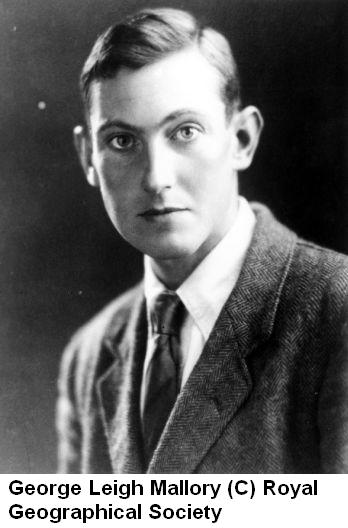
George Leigh Mallory was born in Mobberley, Cheshire England on the 18th June 1886. His father, George Leigh Mallory NewHerbert Leigh Mallory was a clergyman to the local parish church, who married George’s mother, Annie in 1882. George had two sisters, Mary and Annie Victoria (known as Avie), also a younger brother Trafford. George had a happy childhood and was given considerable freedom which led to many adventurous escapades.

In 1896, George attended Glengorse, a boarding school on the south coast of England, From there he won a scholarship to Winchester College. It was here that George was introduced to rock climbing and mountaineering by R Irving, a master at the college, who every year took some of his pupils climbing in the Alps. In 1905, George went to the Magdalene College in Cambridge.

Once George took his degree in history he decided to stay in Cambridge and wrote an essay that was later published as Boswell the Biographer. George had now decided to become a teacher. In 1910 he began teaching at Chartherhouse School in Surrey.
While at Charterhouse George met Ruth, and they were married in 1914. George and Ruth had two daughters, Clare and Beridge and a son, John. As 1915 came to a close George signed up to the Royal Garrison Artillery and in 1916 he went to war and took part in the shelling of the Somme.

After the war George returned to Charterhouse as a teacher where he resigned in 1921 to join the first Everest expedition. In 1923 he took a job as lecturer at the Cambridge University. Again, George was given temporary leave so that he could join the 1924 Everest attempt.

In 1904, in a party led by Irving, George attempted to climb Mont Velan in the Alps, but he turned back not far from the summit due to altitude sickness. In 1911, George, again with a party led by Irving, reached the summit of Mont Blanc as well as Mont Maudit.
By 1913 George was at the peak of his rock-climbing powers and ascended Pillar Rock in the Lake District, England. He climbed it with no aid or assistance which has been graded as ’Hard Very Severe’. It is now known as ’Mallory’s Route’.

In 1921 George took part in the British Reconnaissance Expedition, organised and financed by the Mount Everest Committee. The expedition produced the first accurate maps of the region around the mountain. George was accompanied by several members of the British Alpine Club and surveyors based in India.

George and his climbing partners, G Bullock and E Wheeler, with the aid of some Sherpas, climbed several smaller peaks in the Everest region, including the North Col, to take a closer look at Everest and to view any potential route to the summit. After circling the mountain from the south side, his party finally discovered the East Rongbuk Glacier. By climbing up to the saddle of the North Ridge, Mallory not only became the first to set foot on Everest, but also saw a route to the summit via the North-East Ridge.

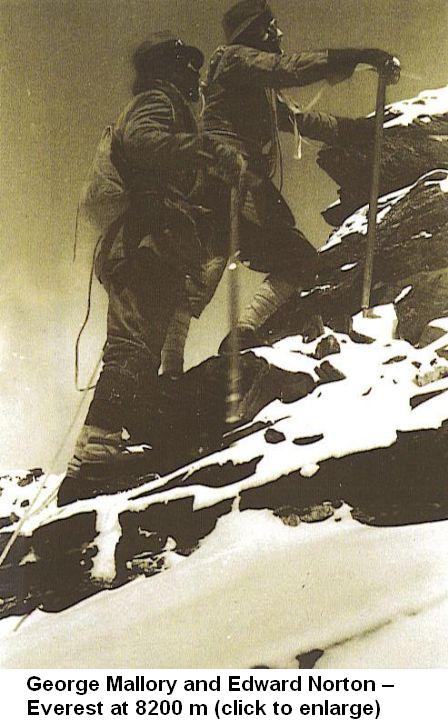
In 1922 George returned to Mount Everest as a member of the party led by General Charles Bruce, with the hope of making a serious attempt for the summit. George led his climbing team of Howard Somervell and Edward Norton almost to the crest of the North-East ridge, before weather conditions and the late hour forced them to retreat. A second party led by George Finch reached a height of approx. 27,300 feet (8,321 m) using bottled oxygen. Determined for one more try George organised a third attempt on the summit, which would end in disaster. As George was leading a group of porters on the lower slopes of the North Col in fresh, waist-high snow, an avalanche swept over the group, killing seven Sherpas. The attempt was immediately abandoned. (There is one of most famous photo in the world. George Mallory and Edward Norton – Everest at 8200 m. They ascended without use of oxygen. British expedition – 1922 r. – take a look at my photo gallery which pictures the story of the discovery and climbing the Mt. Everest : – discovery and climbing Everest.

George went to Mount Everest again in 1924, his third time. The expedition was led by General Charles Bruce as in 1922. The first attempt for the summit was George and Geoffrey Bruce, and then another by Edward Norton and Howard Somervell, all which ended in failure to reach the summit. In an third attempt George chose Andrew Irvine as his partner and this time decided to use oxygen. On the 8th June George and Andrew left the safety of Camp V1 for their attempt to reach the summit. Noel Odell who was climbing up behind them in support reported the following:

“At 12.50, just after I had emerged from a state of jubilation at finding the first definite fossils on Everest, there was a sudden clearing of the atmosphere, and the entire summit ridge and final peak of Everest were unveiled. My eyes became fixed on one tiny black spot silhouetted on a small snow-crest beneath a rock-step in the ridge; the black spot moved. Another black spot became apparent and moved up the snow to join the other on the crest. The first then approached the great rock-step and shortly emerged at the top; the second did likewise. Then the whole fascinating vision vanished, enveloped in cloud once more.”

George Leigh Mallory and Andrew Irvine were never seen again.

Back in Britain the news of Mallory and Irvine’s disappearance came as a shock and was widely mourned to the extent that the two were hailed as national heroes.

In 1999 the body of George Leigh Mallory was found high on the North Face of Everest.

The above Questions & Answers are (C) Copyright of Mount Everest The British Story

* Source : – http://www.everest1953.co.uk/

** Previous story :- George Mallory & Andrew Irvine Tribute - video on YouTube.

- Mallory's Clothing Could Have Climbed Mt. Everest.

www.Everest1953.co.uk

goryonline.com

** zapraszam do subskrypcji mojego bloga :

AddThis Feed Button

** zapraszam na relacje z wypraw polskich himalaistów.

George Mallory & Andrew Irvine Tribute - video on YouTube.

Posted by himalman On 7/09/2009 01:13:00 pm 0 comments
I would like to invite you to watch one of movie of Everest collection…
George Mallory & Andrew Irvine Tribute - video on YouTube.

George Leigh Mallory and Andrew Irvine were two English mountaineers who took part in a British expedition to Mount Everest in 1924. On the 8th June, both disappeared somewhere high on the North-East ridge during (or perhaps after completing) the final stage of their attempt to make the first ascent of the world's highest mountain, 29 years before Hillary and Norgay. The pair's last known sighting was only a few hundred metres from the summit. Mallory's ultimate fate was unknown for 75 years, until his body was finally discovered in 1999. Whether or not they reached the summit before they died remains a subject of speculation and continuing research.


* Source : – http://everest1953.blogspot.com/ ; – http://www.youtube.com/

** Previous story : - VIDEOS.

www.Everest1953.co.uk


goryonline.com


* zapraszam do subskrypcji mojego bloga :

AddThis Feed Button

** zapraszam na relacje z wypraw polskich himalaistów.

Sociofluid

Promote cool website

Climbing courses and training - PZA Climbing Center in Tatras
One of best website about Mt Everest
www.Everest1953.co.uk
You can help

Trekking agency

advertise on blog

MY Favorite books...


    Polish Himalayas on Facebook

    Great tops for everyone!

    Mountaineering is my hobby and profession of walking, hiking, trekking and climbing up mountains. It is also sometimes known as alpinism, particularly in Europe.

    Picasa Web Albums

    Himalman's Weblog