Trekking Tours

Posted by Author On 5/29/2009

POST-SUMMARY-HERE

Everest, Everest History, Everest Firsts

Posted by Author On 5/29/2009

POST-SUMMARY-HERE

Expedition, expedition list, expeditions on 8000m peaks

Posted by Author On 5/29/2009

POST-SUMMARY-HERE

Showing posts with label Polish climbers. Show all posts

Events - Polish climbers in Himalayas.

Posted by himalman On 7/19/2009 08:18:00 am 0 comments

Climbers.

Posted by himalman On 6/08/2009 08:29:00 am 0 comments
Climbing is the activity of using one's hands and feet (or indeed any other part of the body) to ascend a steep object. It is done both for recreation (to reach an inaccessible place, or for its own enjoyment) and professionally, as part of activities such as maintenance of a structure, or military operations.

Climbing activities include:

  • Bouldering: Ascending boulders or small outcrops, often with climbing shoes and a chalk bag or bucket. Usually, instead of using a safety rope from above, injury is avoided using a crash pad and a human spotter (to direct a falling climber on to the pad).
  • Buildering: Climbing urban structures - usually without equipment - avoiding normal means of ascent like stairs and elevators. Aspects of buildering can be seen in the art of movement known as Parkour.
  • Canyoning: Climbing up canyons for sport or recreation.
  • Competition Climbing: A formal, competitive sport of recent origins, normally practiced on artificial walls that resemble natural rock formations. The International Federation of Sport Climbing (IFSC) is the official organization governing competition climbing worldwide and is recognized by the IOC and GAISF and is a member of the International World Games Association (IWGA). Competition Climbing has three major disciplines: Lead, Bouldering and Speed.
  • Ice climbing: Ascending ice or hard snow formations using special equipment designed for the purpose, usually ice axes and crampons. Protective equipment is similar to rock climbing, although protective devices are different (ice screws, snow wedges).
  • Mountain climbing (Mountaineering): Ascending mountains for sport or recreation. It often involves rock and/or ice climbing.
  • Net climbing: Climbing net structures. The climbing structures consist of multiple interconnected steel reinforced ropes attached to the ground and steel poles. Climbing nets are usually installed on playgrounds to assist children in developing their balancing and climbing skills.
  • Pole climbing (gymnastic): Climbing poles and masts without equipment.
  • Pole climbing (lumberjack): Lumberjack tree-trimming and competitive tree-trunk or pole climbing for speed using spikes and belts.
  • Rock climbing: Ascending rock formations, often using climbing shoes and a chalk bag. Equipment such as ropes, bolts, nuts, hexes and camming devices are normally employed, either as a safeguard or for artificial aid.
  • Rope access: Industrial climbing, usually abseiling, as an alternative to scaffolding for short works on exposed structures.
  • Rope climbing: Climbing a short, thick rope for speed. Not to be confused with roped climbing, as in rock or ice climbing.
  • Tree climbing: Ascending trees without harming them, using ropes and other equipment. This is a less competitive activity than rock climbing.

Rock, ice, and tree climbing all usually use ropes for safety or for aid. Pole climbing and rope climbing were among the first exercises to be included in the origins of modern gymnastics in the late 18th century and early 19th century.

goryonline.com

* zapraszam do subskrypcji mojego bloga :

AddThis Feed Button

** zapraszam na relacje z wypraw polskich himalaistów.

EVENTS

Posted by himalman On 6/07/2009 11:16:00 am 0 comments

Biggest tragedy of Polish climbers in Himalayas on Mt. Everest -

- Mount Everest Expedition 1989.

Previously, the worst single accident on Mount Everest had occurred in 1989, when five Polish climbers died in an avalanche.

On May 27, 1989 died in avalanche on Lho La : Mirosław Falco-Dąsal, Mirosław Gardzielewski, Zygmunt Andrzej Heinrich and Andrzej Otręba.

Eugeniusza Chrobaka who has survived in avalanche died next day on Lho La. He and Andrzej Marciniak successfully summitted Mount Everest on May 24, 1989.

20 rocznica tragedii na Lho La
w niedzielę 31.05.09 o godz. 13 zostanie odprawiona Msza św. żałobna w kościele na Wiktorówkach.

W 20 rocznicę tragicznej śmierci pod Everestem himalaistów: Eugeniusza Chrobaka, Mirosława Falco-Dąsala, Mirosława Gardzielewskiego, Zygmunta Andrzeja Heinricha i Andrzeja Otręby.

tablica Mount Everest Expedition 1989

Tablica poświęcona jest uczestnikom najbardziej tragicznej z polskich wypraw w Himalaje, w której w maju 1989r zginęło 5ciu Polaków.

Wyprawa miała zdobywać Everest tzw zachodnia droga, zwana tez jugosłowiańska, bo to oni pokonali ja Chrobak z sukcesem w 1979r. Droga najdłuższa i uważana za najtrudniejsza, wiedzie przez tzw. Zachodnie Plecy i prowadzi przez Khumbutse, Lho La i bardzo eksponowany teren. Wymaga pokonywania wielu trudności, poreczowania, zabezpieczania szlaku aż do wierzchołka, a wiec dużo pracy dla wielu ludzi oraz dużo sprzętu. Z wielkim trudem całej wyprawy udało się “zrobić cały szlak”. Po wyczerpującej wspinaczce 24.05.1989r na Everescie stanęli Eugeniusz Chrobak i Andrzej Marciniak.

Tragedia rozegrała się w drodze powrotnej gdy wydawało się, ze już są bezpieczni.

Na spotkanie wracających zdobywców wyszli z bazy Andrzej “Zyga” Heinrich, dla którego zawsze było Heinrich mało wspinaczki i Wacław Otręba, a w “jedynce” byli i czekali Mirosław “Falco” Dąsal i Mirosław Gardzielewski. Trzy zespoły spotkały się w jedynce w piątek wieczorem i czuli się tu bezpiecznie, bo tyle razy z tego miejsca wspinali się wyżej na szczyt, ze traktowali jedynkę niemal jak bazę, a przed sobą mieli szlak najczęściej pokonywany wcześniej czyli forsowne przejście przez Khumbutse.

Na przełęczy szalała śnieżyca, a w bazie czekali niecierpliwie, aż lada moment szóstka z Lho La wyłoni się z tej strony góry. 27 maja po 13tej w radio rozległy się trzaski, a potem usłyszeli głos Marciniaka o tragedii, o tym ze zeszła lawina z Khumbutse. DąsalZ lawiny ocaleli tylko zdobywcy Everestu, ale Chrobak miał złamana nogę i był w szoku. Potem zeszła kolejna lawina, a rano (28.05.1989r) okazało się ze Chrobak już nie oddycha.

Marciniak znalazł się w bardzo trudnym położeniu, pomoc z bazy była niemożliwa, nie miał zapasów, sprzętu, a na dodatek błądzenia w śnieżycy bez okularów spowodowały porażenie wzroku, był “ślepy”. Znalazł jednak na tym śnieżnym pustkowiu namiot, a w nim trochę jedzenia i gazu oraz lekarstwo na oczy. To znalezisko było niemal cudem, tak jak cudem było zachowanie łączności z baza i bezprecedensowa akcja ratunkowa przez Tybet, która pozwoliła mu ocaleć. Gardzielewski

Marciniak został uratowany po skomplikowanej akcji ratunkowej, zoraganizowanej przez Artura Hajzer, w której uczestniczyli m.in. : Rob Hall i Garry Ball.

O samej akcji ratunkowej w kolejnych postach.

* zobacz też :

- Breaking news: Piotr Morawski lost on Dhaulagiri. Piotr Morawski zginął na Dhaulagiri. /Version english and polish/

baner funda kukuczki  468 Biggest tragedy of Polish climbers in Himalayas   Mount Everest Expedition 1989. Everest za cenę życia.

gory Biggest tragedy of Polish climbers in Himalayas   Mount Everest Expedition 1989. Everest za cenę życia.

houseonline gora 468 Biggest tragedy of Polish climbers in Himalayas   Mount Everest Expedition 1989. Everest za cenę życia.

 Biggest tragedy of Polish climbers in Himalayas   Mount Everest Expedition 1989. Everest za cenę życia.

** zapraszam na relacje z wypraw polskich himalaistów.

Winter Broad Peak timeline: No winners yet in a tough game

Posted by himalman On 12/18/2008 09:38:00 am 1 comments

ExWeb special - Winter Broad Peak timeline:
No winners yet in a tough game

(K2Climb.net/MountEverest.net) Up until now only 8 out of all 14 eight-thousanders have been winter climbed. Over the previous weeks ExWeb have run debriefs on all the first winter ascents, and also all winter, or near winter, summits in Himalaya.

But what about winter attempts on the peaks ahead? Last week Simone Moro offered winter history for Makalu; while ExWeb’s contributor Rodrigo Granzotto Peron dodged flooding and power outages in his home town of Brazil for a skinny on the remarkably few winter attempts on Broad Peak and Nanga Parbat (check in for NP tomorrow).

trasa-zima-broad-peak

HiMountain winter expedition to Broad Peak - 2008/09 - route


Broad Peak Winter History
By Rodrigo Granzotto Peron

For two weeks in the winter of 1983, Andrzej Zawada and Jacques Olek researched the Baltoro Glacier; checking the weather and routes on Broad Peak and both Gasherbrums for future expeditions. Their conclusion was that “winter conditions were much more severe than in the Everest region.”

Polish climbers breaking trail

Five years later, in February 1988 Polish Maciej Berbeka (Manaslu winter 84, Cho Oyu winter 85) arrived for the first winter attempt on Broad Peak. It became the most successful winter climb on Falchan Kangri yet.

Berbeka reached the Foresummit by the normal route one month later. Very strong winds blowing from the real summit prevented him to do the first winter ascent of an 8000er in Pakistan.

Here come the Spaniards

In 2003 Spanish Juanito Oiarzabal arrived with a strong team: Juan Vallejo, Mikel Zabalza, Losu Bereziartu and Italian Silvio Mondinelli. They reached 6500m on the normal route, but after the destruction of Camp II (February 9th) and Camp I (February 20th), they headed home without summit.

(Ed note: the Spanish team reportedly said that just to get to BC was a long, frozen walk from hell.)

Latest attempts: another Italian against all odds

Four years later, in 2007 Simone Moro decided to try his luck, teaming up with Pakistan Shaheen Baig, again on the normal route. Progress was very slow as a result of high winds and incredible amount of snow on the route. The expedition was called off after reaching 6800 meters.

With valuable experience bagged, Simone Moro was back already the next year, in 2008 with Pakistan climbers Shaheen Baig and Quadrat Ali. But logistics wrecked the schedule right from the start.

The three climbers arrived BC very late (February 2nd). According to Simone, “this expedition is a charade of inefficiency, bad luck and unhelpful people.” Still, the mountaineers climbed the normal route until 7800 meters before calling the expedition off due to high winds in early March.

* see :

- Ice Warriors not give up - HiMountain winter expedition to Broad Peak - 2008/09. HiMountain wyprawa zimowa Broad Peak - 2008/09. /Version english and polish/

- Don Bowie’s website

- Polish winter expedition to K2, 2002/3 /Version polish and english/

- Polish-Italian winter expedition to Shisha Pangma (8027m), 2005 /Version polish and english/

- Winter Manifesto of Krzysztof Wielicki - Manifest zimowy Krzysztofa Wielickiego /Version polish and english/

- 2007 Winter Nanga Parbat: It’s over - http://www.mounteverest.net/news.php?id=15523

Exweb Week-In-Review is sponsored by HumanEdgeTech the world’s premier supplier of expedition technology. Our team helps you find ultra light expedition tech that works globally.
e-mail or call +1 212 966 1928

** Read these stories - and more! - at ExplorersWeb.com

*** oryginal post by : - http://himalman.wordpress.com/

“Ice Warriors” not give up.
HiMountain winter expedition to Broad Peak - 2008/09.

The eighties are long gone but a warrior’s soul never dies: The tough bunch of climbers who wrote the coolest pages of mountaineering history 20 years back are still kicking - and more. In only a few weeks, they will take on any mountaineer’s ultimate nightmare: A winter climb on a Pakistan 8000er.
Not even Messner could beat them: Polish climbers have all the first winter ascents on Himalayan 8000ers.

Winter Manifesto of Krzysztof Wielicki :

The golden decade of Polish Himalayan mountaineering, besides the unquestionable personal accomplishments of Jurek Kukuczka, Wanda Rutkiewicz, Wojtek Kurtyka and others, also saw winter achievements that were a team rather than individual success. It was particularly noticeable during the winter expeditions how the whole team worked for the result. In Winter it is difficult to achieve success without teamwork. Climbing in the Alps or the Tatras in wintertime is no longer surprising to anyone: it was the natural course of things, an attempt to raise the challenge without raising the altitude. The same had to occur in high mountains too.And it’s great that it was achieved by Poles. Jurek Werteresiewicz drew up a programme, Andrzej Zawada implemented it and many of us put it into practice, often successfully but there were failures as well.In recent years a total withdrawal from wintertime climbing could be observed in the Tatras, the Alps as well as the Himalayas…..

… We were successful in high mountain winter explorations. After all, half of fourteen 8000-metre peaks were climbed by Poles, with in just eight years (1980-1988) to boot. Six unconquered peaks are waiting for us, but volunteers are nowhere to be seen. Let the nickname “Ice Warriors”, given us by Englishmen, be inscribed in the history of Himalayan climbing for ever.

Today started next winter expedition -

HiMountain winter expedition to Broad Peak - 2008/09.
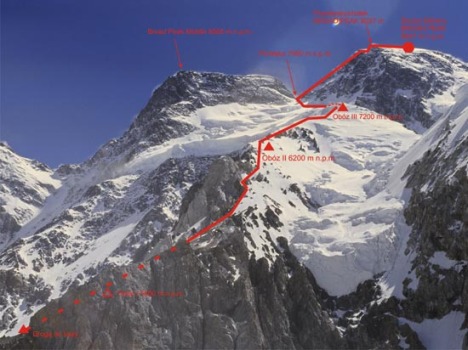
trasa-zima-broad-peak

HiMountain winter expedition to Broad Peak led by Artur Hajzer , the team : Robert Szymczak and Don Bowie from Canada.

Artur Hajzer is a Polish mountaineer best known for the first winter ascent of Annapurna on February 3, 1987 together with Jerzy Kukuczka. He was member of latest winter expedition - 2006/07 Winter Nanga Parbat!

Upcoming winter expeditions on 8000es

Artur Hajzer will lead Robert Szymczak and Don Bowie for a winter attempton Broad Peak; Jacek Teler will lead a team on Nanga Parbat. Simone Moro will attempt Makalu, teaming up with Denis Urubko. Pavel Krupièka, Jan Krabec and Milan Wlasák will atempt Manaslu.

* see :

- Don Bowie’s website

- Polish winter expedition to K2, 2002/3 /Version polish and english/

- Polish-Italian winter expedition to Shisha Pangma (8027m), 2005 /Version polish and english/

- Winter Manifesto of Krzysztof Wielicki - Manifest zimowy Krzysztofa Wielickiego /Version polish and english/

- 2007 Winter Nanga Parbat: It’s over - http://www.mounteverest.net/news.php?id=15523

Lodowi wojownicy nie dają za wygraną.

HiMountain wyprawa zimowa Broad Peak — 2008/09

Rusza kolejna polska zimowa wyprawa na ośmiotysięcznik — „HiMountain wyprawa zimowa Broad Peak — 2008/09”. Celem wyprawy jest pierwsze w historii zimowe wejście na 12-ty szczyt świata Broad Peak (8051 m) w Karakorum (Pakistan).

Himalaizm zimowy to iście polska specjalizacja. Mimo dużej ilości prób podejmowanych przez najlepszych alpinistów z całego świata, tylko Polacy (wyjątkiem jest Włoch Simone Moro, który zdobył Shisha Pangma razem z Piotrem Morawskim - Polish-Italian winter expedition to Shisha Pangma (8027m), 2005 /Version polish and english/) stawali do tej pory na ośmiotysięcznikach zimą (zdobyli już osiem). Jak pisał Krzysztof Wielicki w swoim słynnym Manifeście… “Niech przydomek ” Ice Warriors”, nadany nam przez Anglików, na stałe zapisze się w historii himalaizmu.” Ostatnia zimowa próba to Winter Nanga Parbat - zimowa wyprawa Wielickiego z 2007r ; niestety wyprawa nie zakończyła się sukcesem , himalaistów pokonała pogoda.

Sześć spośród czternastu ośmiotysięczników pozostaje niezdobytych, z tego pięć w Pakistanie i jeden w Nepalu.

trasa-zima-broad-peak

Trasa wyprawy zimowej na Broad Peak 2008/09

Wspomniany Simone Moro dwukrotnie próbował zmierzyć się zimą z Broad Peakiem, za każdym razem bezskutecznie. Co znamienne, żaden spośród pięciu pakistańskich ośmiotysięczników (cztery w Karakorum oraz Nanga Parbat) nie został do tej pory zdobyty zimą. O krok od wejścia na główny wierzchołek Broad Peaku zimą był Maciej Berbeka. Osiągnął on przedwierzchołek, tzw. Rocky Summit (8035 m), który jest niższy od wierzchołka głównego zaledwie o 16 metrów, ale oddalony od niego o godzinę wspinaczki.
martyna-wojciechowska-artur-hajzer-i-robert-szymczak-new

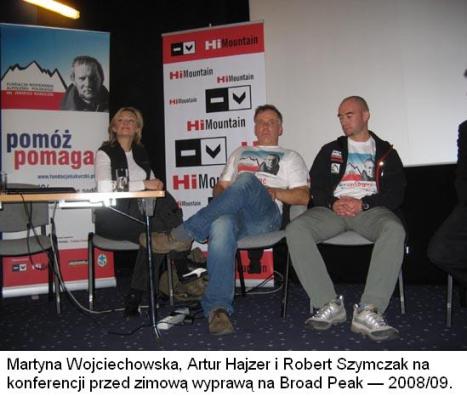
W przeddzień odlotu wyprawy, 8 grudnia 2008, w warszawskim Centrum Olimpijskim odbyła się konferencja prasowa uczestników wyprawy, którą prowadziła zdobywczyni Everestu, redaktor naczelna National Geographic Polska, Martyna Wojciechowska.

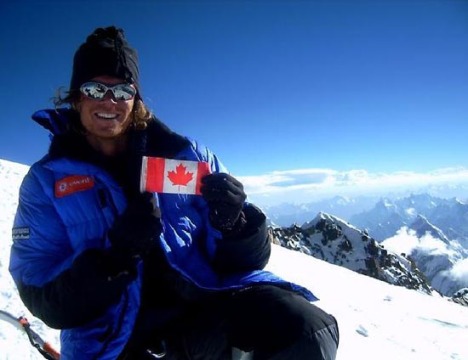
W wyprawie uczestniczy trzech himalaistów: Artur Hajzer — kierownik, Robert Szymczak i Don Bowie z Kanady. Wspomagani będą przez dwu tragarzy wysokościowych.
don-bowie

Don Bowie.

Sprzęt i żywność wyprawy, w sumie 86 ładunków, zostały już dostarczone do podnóża góry na lodowcu Godwin Austen i oczekują w miejscu, gdzie stanie baza wyprawy. Ładunki przetransportowano już 15 października, ponieważ — jeżeli wierzyć zapewnieniom pakistańskiej agencji — w okresie zimowym nie jest możliwe, aby w tamtym rejonie przeszła karawana tragarzy. Uczestnicy wraz ze sprzętem osobistym i ładunkami uzupełniającymi mają dolecieć do bazy helikopterem między 19 a 21 grudnia 2008 roku.

* strony o wyprawach zimowych :

- 2007 Winter Nanga Parbat: It’s over - http://www.mounteverest.net/news.php?id=15523

- Polish winter expedition to K2, 2002/3 /Version polish and english/

- Polish-Italian winter expedition to Shisha Pangma (8027m), 2005 /Version polish and english/

- Winter Manifesto of Krzysztof Wielicki - Manifest zimowy Krzysztofa Wielickiego /Version polish and english/


goryonline.com

** zapraszam na relacje z wypraw polskich himalaistów.

*** Źródła : - wiadomośći PZA - http://himalman.wordpress.com/

Sociofluid

Promote cool website

Climbing courses and training - PZA Climbing Center in Tatras
One of best website about Mt Everest
www.Everest1953.co.uk
You can help

Trekking agency

advertise on blog

MY Favorite books...


    Polish Himalayas on Facebook

    Great tops for everyone!

    Mountaineering is my hobby and profession of walking, hiking, trekking and climbing up mountains. It is also sometimes known as alpinism, particularly in Europe.

    Picasa Web Albums

    Himalman's Weblog