Trekking Tours

Posted by Author On 5/29/2009

POST-SUMMARY-HERE

Everest, Everest History, Everest Firsts

Posted by Author On 5/29/2009

POST-SUMMARY-HERE

Expedition, expedition list, expeditions on 8000m peaks

Posted by Author On 5/29/2009

POST-SUMMARY-HERE

Showing posts with label British climber. Show all posts

Michael 'Bronco' Lane - Interview.

Posted by himalman On 8/05/2009 09:46:00 am 1 comments

In 1976 legendary climber Major Michael ‘Bronco’ Lane joined the first all-military expedition to climb Mount Everest.

Michael 'Bronco' Lane reached the summit of Mount Everest on the 16th May 1976 with fellow partner John 'Brummie' Stokes while on the Joint British Army & Royal Nepalese Army Everest Expedition. Bronco then went on to be leader of the 1983 Special Air Service Regiment Everest Expedition.

‘Bronco Lane is an exceptional soldier whose spirit of adventure and readiness to take risks has led him to the most extreme and dangerous places on earth - including the summit of Mt. Everest.’ - General Michael Rose.


Brummie and Bronco, Brummie being the one on the right.

Source: John "Brummie" Stokes


1. You joined the Army Mountaineering Association while in the Special Air Service. Do you think you would of started climbing if it wasn’t for the Army?

I joined the Army aged 16 as a Junior Leader in November 1961 after being introduced to basic mountaineering whilst participating on an Ullswater Outward Bound Course. 'Topper Brown' my first Troop Sergeant had been an instructor at Tywyn Army Outward Bound School and he continued to nurture an interest in general. However it was not until I joined 22 SAS Regiment in 1967 and found myself in a Mountain Troop that I really developed my involvement.

2. Its been 33 years since you were on the Summit of Mount Everest. Do you still remember your time up there?

Yes I do have a series of selected memories, probably nurtured by my still giving the odd slide presentation. Besides the obvious ones of isolation, cold and effects of altitude the single over-riding aspect is one of a total focus to just keep going -eight to ten steps at a time - then a long pause to recover and move on again, for as long as it takes.


3. You left your top camp at 6am for the summit and had agreed with Brummie Stokes that if you were not on the summit by midday you would turn around and head back. You both reached the summit at 3.15, what happened to your turn around time?

We paused on reaching the South Summit at 1pm, when a short break in the clouds gave us a tantalising view of the Hillary Step and the final summit slopes.

I remember looking at my watch, noting the time and turning to Brum gave him a 'thumbs up'! He replied with an affirmative 'thumbs up' and I continued to traverse the cornice ridge across to the Step. In a similar situation I very much doubt if any mountaineer anywhere near the summit of Everest would have reacted differently.


4. On the descent you and Brummie Stokes were forced to bivouac because of the bad weather. During that night did you ever imagine that you would survive to see the morning?

We left the summit at about 15:40 in poor visibility and with very little oxygen left. We had cached a spare bottle at 28,000 feet and our over-whelming need was to find this. We safely abseiled back down the Hillary Step and somehow reached the South Summit, after which a combination of thick cloud, total lack of trail and no oxygen had us stumbling onwards, in a pretty bad state. Then, just at last light and without any illumination, we arrived at our upright orange bottle stuffed in a snow bank.

Totally exhausted in the darkness we huddled facing each other sitting on our sacks with the bottle between us. Brum had the first go at connecting and could not get a secure join and slumped. In total desperation, I took off my outer mitt and wearing just my thin contact glove was able to get a sound coupling. We swapped over the mask every few minutes through-out the long night. Both of us experienced hallucinations and rubbed each others backs and legs to stimulate circulation, as we slipped in and out of unconsciousness. Fortunately never both of us together.

Around about midnight, the storm died down and it became a cold, clear but luckily a windless night, which was our salvation.


I do not recall ever thinking "I'm not going to make it". Possibly soldiers have that part of their psyche removed early in basic training, as there will be lots of times on active operational service when all that goes through the mind is "Stick It! Stick It! Stick!" to keep you alive.

5. Due to the cold you lost 5 fingers and 10 toes. How long did it take you to recover from this ordeal?

Three months later during a very hot summer, we had the frost bitten digits surgically removed by Mr Charles Renton, a well respected surgeon at Hereford County Hospital. It would take a further six months for the stumps to heal sufficiently for our return to active service with the unit.

6. Is it true that you gave the National Army Museum your 5 fingers and 10 toes for them to exhibit in the museum?

Yes. They had originally been donated to the London Wellcome Museum for their medical exhibition and following a re-organisation were returned and I kept them in my garage. Some years later whilst giving a lecture at the National Army Museum Chelsea, to promote my book Military Mountaineering, I was asked if I had anything suitable for a permanent loan. So the digits found another useful home, from where they have made special 'guest' appearances here and there.

7. What is your view on the many commercial expeditions that are on Everest every year?

Amongst the many negative aspects, to my mind the one major plus factor is that a good percentage of the wealth generated today on Everest remains with the Sherpa peoples of the Solu Khumbu.

8. Of all the mountains you have climbed on around the world which is your favourite?


In the summer of 1972 I was a member of the 12 strong AMA Axel Heiburg Expedition in the Canadian Arctic. We split into teams of four and ours spent six weeks in the field climbing virgin peaks accessed by glaciers. We climbed over 30 and I named one 'Kneecap' in recognition of Brum who was absent having his shattered kneecap removed, following an incident in the Dhofar War when he'd tried to stop an AK47 round.

9. Today, most items used on Everest are lighter, smaller and of better quality. Which item used today would you of liked back in 1976?

Double Plastic High Altitude Boots so I could still walk around barefooted!

And finally, my last question.

10. Do you think that George Mallory and Andrew Irvine climbed the Second Step?

Yes I most certainly do!

The above Questions & Answers are (C) Copyright of Mount Everest The British Story

* Source : - http://www.everest1953.co.uk/BroncoLane.html

www.Everest1953.co.uk


goryonline.com


* zapraszam do subskrypcji mojego bloga :

AddThis Feed Button

** zapraszam na relacje z wypraw polskich himalaistów.

Andrew Comyn Irvine one of the famous British climber.

Posted by himalman On 7/13/2009 06:17:00 am 1 comments

Andrew Comyn (Sandy) Irvine was born in Birkenhead England on the 8th April 1902. His father, Andrew Irvine  NewWilliam Fergusson Irvine, a business man, married Andrews mother, Lilian Davies-Colley, and eventually went on to have a large family. Andrew had four brothers, Hugh, Kenneth, Alexander (known as Alec) and Thomas (known as Tur) plus one sister, Evelyn.

Andrews childhood was full of adventure as most youngsters were, but he was also brought up with strict rules and discipline from both very religious parents. Andrew was educated at Birkenhead and Shrewsbury School’s before going to Merton College in Oxford to study engineering. Andrew was also a very keen sportsman and became a member of the Oxford crew for the Oxford and Cambridge Boat Race in 1922 and 1923.

Andrew was very good with his hands, and he had the ability to fix or improve anything mechanical. It was during the First World War, while Andrew was still a schoolboy, he sent the War Office a design on paper to allow a machine gun to fire from a propeller-driven aeroplane without damaging the propeller’s blades.

In 1919, Andrew rode his motorcycle to the top of a 3000-foot Welsh mountain, Foel Grach, where he surprised Noel Odell and his wife who had climbed it on foot.

In 1923 Andrew was chosen for a expedition to Spitsbergen, where he excelled on every front. It was during this expedition that Noel Odell, the expedition’s leader, had discovered that it was Andrew riding the motorcycle on top of Foel Grach. Noel Odell was so impressed by Andrew that he recommended Andrew for the third British Mount Everest expedition. Andrew was selected on the grounds that he might be the ’superman’ that the expedition needed. Andrew was 21 years old when this opportunity arose.

In 1924 Andrew showed that he was not frighten of hard work. He made major changes to the oxygen apparatus, maintained the expedition’s stoves, camp beds, cameras and many other important devices. Andrew became very popular and respected by his older colleagues.

Andrew was to find himself teamed up with George Leigh Mallory on the last summit attempt after a previous two attempts had failed. Using oxygen for this attempt they reached Camp V1 with no real problem.

On the 8th June 1924 expedition member Noel Odell reported seeing them at 12:50 pm ascending one of the major “steps” on the ridge and “going strongly for the top”. That was the last time they were seen alive.

When Odell returned to the tent at Camp V1 the following day to see if Mallory and Irvine were there, he found the inside of tent covered in bits and pieces from the oxygen apparatus. So it looks like that the young Andrew was still maintaining the oxygen apparatus the night before or the morning of their summit attempt.

The body of Andrew ‘Sandy’ Irvine has never been found.

The above Questions & Answers are (C) Copyright of Mount Everest The British Story

* Source : – http://www.everest1953.co.uk/ChrisBonington

** take a look at my photo gallery which pictures the story of the discovery and climbing the Mt. Everest :

- discovery and climbing Everest.

** Previous story : - George Leigh Mallory one of the famous British climber.

www.Everest1953.co.uk

goryonline.com

** zapraszam do subskrypcji mojego bloga :

AddThis Feed Button

** zapraszam na relacje z wypraw polskich himalaistów.

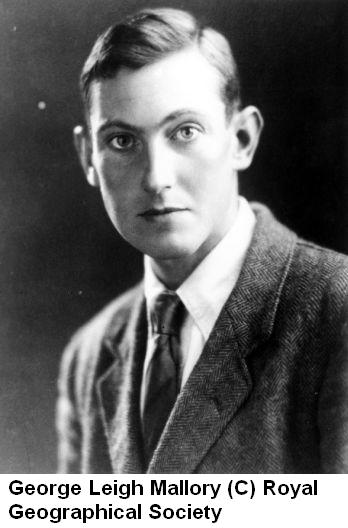
George Leigh Mallory one of the famous British climber.

Posted by himalman On 7/10/2009 07:40:00 am 2 comments

George Leigh Mallory was born in Mobberley, Cheshire England on the 18th June 1886. His father, George Leigh Mallory NewHerbert Leigh Mallory was a clergyman to the local parish church, who married George’s mother, Annie in 1882. George had two sisters, Mary and Annie Victoria (known as Avie), also a younger brother Trafford. George had a happy childhood and was given considerable freedom which led to many adventurous escapades.

In 1896, George attended Glengorse, a boarding school on the south coast of England, From there he won a scholarship to Winchester College. It was here that George was introduced to rock climbing and mountaineering by R Irving, a master at the college, who every year took some of his pupils climbing in the Alps. In 1905, George went to the Magdalene College in Cambridge.

Once George took his degree in history he decided to stay in Cambridge and wrote an essay that was later published as Boswell the Biographer. George had now decided to become a teacher. In 1910 he began teaching at Chartherhouse School in Surrey.
While at Charterhouse George met Ruth, and they were married in 1914. George and Ruth had two daughters, Clare and Beridge and a son, John. As 1915 came to a close George signed up to the Royal Garrison Artillery and in 1916 he went to war and took part in the shelling of the Somme.

After the war George returned to Charterhouse as a teacher where he resigned in 1921 to join the first Everest expedition. In 1923 he took a job as lecturer at the Cambridge University. Again, George was given temporary leave so that he could join the 1924 Everest attempt.

In 1904, in a party led by Irving, George attempted to climb Mont Velan in the Alps, but he turned back not far from the summit due to altitude sickness. In 1911, George, again with a party led by Irving, reached the summit of Mont Blanc as well as Mont Maudit.
By 1913 George was at the peak of his rock-climbing powers and ascended Pillar Rock in the Lake District, England. He climbed it with no aid or assistance which has been graded as ’Hard Very Severe’. It is now known as ’Mallory’s Route’.

In 1921 George took part in the British Reconnaissance Expedition, organised and financed by the Mount Everest Committee. The expedition produced the first accurate maps of the region around the mountain. George was accompanied by several members of the British Alpine Club and surveyors based in India.

George and his climbing partners, G Bullock and E Wheeler, with the aid of some Sherpas, climbed several smaller peaks in the Everest region, including the North Col, to take a closer look at Everest and to view any potential route to the summit. After circling the mountain from the south side, his party finally discovered the East Rongbuk Glacier. By climbing up to the saddle of the North Ridge, Mallory not only became the first to set foot on Everest, but also saw a route to the summit via the North-East Ridge.

In 1922 George returned to Mount Everest as a member of the party led by General Charles Bruce, with the hope of making a serious attempt for the summit. George led his climbing team of Howard Somervell and Edward Norton almost to the crest of the North-East ridge, before weather conditions and the late hour forced them to retreat. A second party led by George Finch reached a height of approx. 27,300 feet (8,321 m) using bottled oxygen. Determined for one more try George organised a third attempt on the summit, which would end in disaster. As George was leading a group of porters on the lower slopes of the North Col in fresh, waist-high snow, an avalanche swept over the group, killing seven Sherpas. The attempt was immediately abandoned. (There is one of most famous photo in the world. George Mallory and Edward Norton – Everest at 8200 m. They ascended without use of oxygen. British expedition – 1922 r. – take a look at my photo gallery which pictures the story of the discovery and climbing the Mt. Everest : – discovery and climbing Everest.

George went to Mount Everest again in 1924, his third time. The expedition was led by General Charles Bruce as in 1922. The first attempt for the summit was George and Geoffrey Bruce, and then another by Edward Norton and Howard Somervell, all which ended in failure to reach the summit. In an third attempt George chose Andrew Irvine as his partner and this time decided to use oxygen. On the 8th June George and Andrew left the safety of Camp V1 for their attempt to reach the summit. Noel Odell who was climbing up behind them in support reported the following:

“At 12.50, just after I had emerged from a state of jubilation at finding the first definite fossils on Everest, there was a sudden clearing of the atmosphere, and the entire summit ridge and final peak of Everest were unveiled. My eyes became fixed on one tiny black spot silhouetted on a small snow-crest beneath a rock-step in the ridge; the black spot moved. Another black spot became apparent and moved up the snow to join the other on the crest. The first then approached the great rock-step and shortly emerged at the top; the second did likewise. Then the whole fascinating vision vanished, enveloped in cloud once more.”

George Leigh Mallory and Andrew Irvine were never seen again.

Back in Britain the news of Mallory and Irvine’s disappearance came as a shock and was widely mourned to the extent that the two were hailed as national heroes.

In 1999 the body of George Leigh Mallory was found high on the North Face of Everest.

The above Questions & Answers are (C) Copyright of Mount Everest The British Story

* Source : – http://www.everest1953.co.uk/

** Previous story :- George Mallory & Andrew Irvine Tribute - video on YouTube.

- Mallory's Clothing Could Have Climbed Mt. Everest.

www.Everest1953.co.uk

goryonline.com

** zapraszam do subskrypcji mojego bloga :

AddThis Feed Button

** zapraszam na relacje z wypraw polskich himalaistów.

Sir Chris Bonington - Interview.

Posted by himalman On 6/25/2009 08:54:00 am 0 comments

On the 21st April 1985 Chris Bonington reached the summit of Mount Everest at the age of 51. He was a member of the Norwegian Everest Expedition. He was the leader of the 1972, 1975 and 1982 British Mount Everest expeditions, and has travelled all over the world, making him become one of Britons most successful and loved mountain climbers.

1. You reached the summit of Mount Everest while on a Norwegian expedition, would you of preferredChris Bonington _300 New it to of been on a British expedition with some of your climbing colleagues?

I don’t regret going to the top with a Norwegian Expedition because I made so many life long friends in the course of the expedition, especially Odd Elliassen and Bjorn Myrer Lund with whom I went to the top. And of course, Pertemba Sherpa, who is one of my dearest friends also went to the top with me – he was our Sirdar in 1975 on the South West Face. Apart from anything else, it’s great making climbing friends from around the World.

2. As the leader on the 1972, 1975 and 1982 British Everest expeditions, did the media or anyone else ever try to blame you for the ones that perished and never came home?

NO, there was never any question of that.

3. Are you happier climbing or sat in Base Camp running the expedition as a leader?

I’ve never sat at base camp during an expedition. I believe the best position as leader of a big siege style expedition is to be in the camp just behind the lead climbers. In this way you can have a real feel of what the problems are out in front and also how the supply line is working, getting the big picture of what is going on through out the expedition. I have always done a bit of lead climbing, mainly because that is what I love doing but also, once again to get a feel for the climb. It’s a mistake to spend too much time out in front however because you tend to think tactically and loose sight of what else is going on.

4. What have been your most favourite climbs?

Climbing the West summit of Shivling with Jim Fotheringham – It was a 2 man trip, completely spontaneous, Alpine style, interesting technical climbing to a lovely pointed summit and a scary descent down the other side. Another greast trip was when Charles Clarke and I went into NW Tibet to find Sepu Kangri – this was real exploration – not much climbing, but fascinating country and exploration.

5. Over the years you have sadly lost some very close friends to the mountains. Has it ever made you stop and think why am I doing this (climbing)?

You never get hardened to losing good friends but I love the process of climbing and everything about the mountains so much that I have never thought of giving up.

6. What do you think about all these 'stunts' that happen on Everest? For example the fastest ascent, oldest person, youngest person, snowboarding, wedding vows and even standing naked on the summit.

Thank goodness I got up before the “Stunt “ era. It is of no real significance to mountaineering, but it is a great personal achievement for anyone who gets to the top, and certainly to snow board, parapont, ski from the summit, or for some one wioth a disability, or over 70 to reach the top is also one hell of an achievement. I think this trend is inevitable in the evolution of things.

7. Your wife, Wendy must of hated it every time you said your goodbyes before hopping on a plane for another expedition. Did she ever try and talk you out of going on any?

Wendy has always been 100% behind me on all the climbs I have been on. She fell in love with a mountaineer and has never wanted to change me.

8. Its been nearly 24 years since you reached the summit of Everest. What one item do you think has technically advanced in some way to make climbing Everest easier today than in 1985?

It’s really the arrival of commercial expeditions that run a line of fixed rope from bottom to top and then look after the clients and help them up. Improved oxygen gear and lighter bottles certainly have helped.

9. There are more commercial expeditions on Everest than ever before now. I know that they all bring much needed money into the area, but do you think that there should be a restriction on how many should be allowed on Everest in any one season?

I think there does need to be a level of regulation on Everest both in terms of numbers going on the mountain and also on a code of conduct and guiding qualifications. It seems ironic that guiding on Mont Blanc is very strictly (quite rightly) regulated with the guide needing proper qualifications that demand a long and thorough training, and the guide only having a maximum of, I think it is three, on his rope, whilst on Everest which is infinitely more serious and dangerous, there are no regulations at all.

And finally, my last question.

10: Do you think that George Mallory and Andrew Irvine climbed the Second Step?

I think it is very possible that Mallory climbed the Second Step. He was a very good rock climber, but I think it is unlikely that he and Irvine reached the summit, but you can never be sure, and let’s hope that remains a tantalizing mystery.

If you would like to find out more about Chris Bonington then head over the his website at www.bonington.com

The above Questions & Answers are (C) Copyright of Mount Everest The British Story

* Source : - http://www.everest1953.co.uk/ChrisBonington

www.Everest1953.co.uk


goryonline.com


* zapraszam do subskrypcji mojego bloga :

AddThis Feed Button

** zapraszam na relacje z wypraw polskich himalaistów.
Sociofluid

Promote cool website

Climbing courses and training - PZA Climbing Center in Tatras
One of best website about Mt Everest
www.Everest1953.co.uk
You can help

Trekking agency

advertise on blog

MY Favorite books...


    Polish Himalayas on Facebook

    Great tops for everyone!

    Mountaineering is my hobby and profession of walking, hiking, trekking and climbing up mountains. It is also sometimes known as alpinism, particularly in Europe.

    Picasa Web Albums

    Himalman's Weblog