Trekking Tours

Posted by Author On 5/29/2009

POST-SUMMARY-HERE

Everest, Everest History, Everest Firsts

Posted by Author On 5/29/2009

POST-SUMMARY-HERE

Expedition, expedition list, expeditions on 8000m peaks

Posted by Author On 5/29/2009

POST-SUMMARY-HERE

Showing posts with label Sherpa. Show all posts

Jun 26, 2009
(MountEverest.net/Reported by Ang Karma Sherpa) A historic meet of Sherpa climbers was convened sherpa meetok Newat the National Academy Hall in Kathmandu on 21 June 2009 to address the woes and difficulties of Nepali climbers and current mountaineering related issues in Nepal.
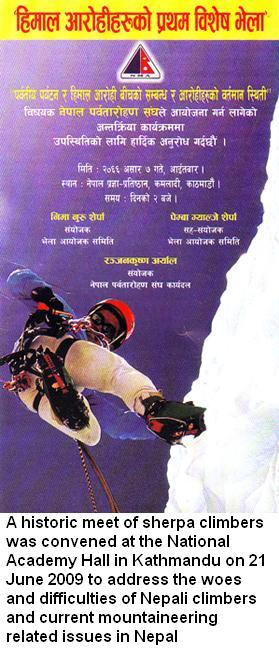
This first ever meet of Nepali climbers in the history of Nepali mountaineering was organized by the task force committee formed by the government to steer the Nepal Mountaineering Association (NMA).

600 Nepali climbers

The meet was attended by 34 regional mountaineers clubs, mountaineering related association/agencies and approximately 600 Nepali climbers and 100 expedition operator representatives.

Over 30 speakers, majority of them comprised of Nepali climbers, spoke on various issues relating to the state of Nepali climbers, Himalayan environment and special provisions to be incorporated in the drafting of the new constitution to address concern of Nepali mountaineers.

“Nepali mountaineers have come of age to lead their own destiny”

In his welcome address, Nima Nuru Sherpa, member of the NMA task force committee & convener of the Meet highlighted the special role and contribution of Nepali climbers towards the development mountaineering activities in particular and tourism in general in Nepal.

He said, “We Sherpas of younger generation are indebted to our forefathers for their hard work and integrity for the glory they brought in the community and nationwide.”

He added, “Mountaineering trends and scenes have changed and our generation needs to be prepared to accept new challenges both on the mountains and policy making level to give new direction to mountaineering activities for the benefit of all. I believe Nepali mountaineers have come of age to lead their own destiny and this meet is to set the first milestone in this regard.”

Pemba Gyalje Sherpa, “does the state know the plight of Nepali climbers when they get old?”

Recipient of National Geographic award of “Adventurer of Year in Heroism in 2008″ the savior in the storm on K2, Pemba Gyalje Sherpa – co-convener of the meet – highlighted problems of the Sherpas in the following words, “Although small in numbers we have made a huge contribution to bring glory to the nation. It is time the Nepali state recognized the contribution made by us and this can be done by making special provision in the drafting of the new constitution.”

He added, “Does the state know the plight of Nepali climbers when they get old and can work for expeditions no more? Many of them have to walk bare feet, their children receive no quality education and when they get seriously injured in the mountains they get no prompt rescue and good treatment afterwards.”

Highlighting the issue further he added, “when they become old or permanently injured from accidents they are left to die on their own – not to mention their widows and children who have no one to support them…”

“Even renowned Nepali climbers are fleeing the country for employment elsewhere because of the state’s neglect. This is going to cost Nepal heavily in the long run, as it will create a void of experienced Nepali mountaineers for future expeditions.”

Pemba also expressed his concern that such a situation is emerging because the Nepal Mountaineering Association, founded to safe-guard the interest and welfare of Nepali mountaineers, has long been run by non-mountaineers.

Mountaineering related agencies to be restructured; guides to obtain international certificates

Nawang Nima Sherpa, member of Nepali Mountaineers’ Welfare & Rights Committee spoke about the need of restructuring mountaineering related agencies in order to recognize and evaluate full potentialities of Nepali climbers in tune with the changing times.

He also mentioned the government and concerned parties have neglected important issues relating to mountaineering and Nepali climbers such as:

- proper regulations to direct mountaineers conduct during expeditions,
- timely reform in the role of liaison officers,
- adequate insurance,
- prompt rescue and evacuation of Nepali climbers during accidents,
- pension and welfare of retired Nepali climbers.

In view of the changing mountaineering trends and scenario in the Himalaya mountains, he also spoke about further upgrading mountaineering skills of Nepali climbers and need for mountaineering schools to produce professional Nepali mountain guides with international diplomas.

Lhakpa, “foreign climbers talk more about their yaks than their Sherpas” – Junila, “parts of royalty fees should cover help to injured Sherpas and their relatives”

Lhakpa Phuti Sherpa, president of Nepal Women Mountaineering Association spoke about the decimation practiced by foreign climbers and mountaineering associations. Quoting from her experience of attending a mountain film festival in Switzerland, she said, “Foreign climbers talk tirelessly about our yaks but hardly mention a word about their expedition Sherpas – who is going to speak about this double standard?”

Usha Bista, Everest summiteer and member of the 2008 Nepal Women expedition to Everest said, “handing out certificates and medals to mountaineers is no longer enough; has the Nepali government done anything for Dharma Raj Rai, who helped Nepali climber and oldest Everest summiteer Min Bahadur Sherchan, 77, to reach Everest summit and lost fingers on both hands in the process?”

Junila Subba, another woman Everest summiteer from the same expedition spoke about the need of inclusion of Sherpa climbers in the policy making body of the government and launch welfare programs to support climbers and their family in such need from the money raised from expedition royalty fees.

Rescue resources, social security, climate change

President of TAAN, Jyoti Adhikari urged the government to make arrangement for education and health and special privileges in transportation and employment for Nepali mountaineers and their families. He also requested the government to take immediate initiatives in developing an effective mechanism for the rescue of mountaineers, both foreigners and Nepali, in case of accidents and selection of liaison officers from Nepali climbers. He demanded social security for climbers and their family after they retire.

Parliamentarian and Constituent Assembly members Ms. Shanta Chaudari and Pasang Sherpa pledged their support to have the interest and rights of Nepali mountaineers addressed in the drafting of new constitution.

They also spoke about the need to save Himalaya from climate change and revenues from mountaineering ploughed back for the betterment of mountain people.

Policies are enough; implementation is what matters

Former Secretary of Nepali Tourism Ministry Dipendra Purush Dhakal said, “Pressuring the government to make policies to address the woes and difficulties of Nepali climbers is a work of a special nature. Drafting policies and regulations alone is not enough; what is important is the implementation and execution part.”

Mr. Dhakal will help prepare a work paper on the meet to present to the government and other concerned agencies.

Ranjan Krishna Aryal, concluded the Meet with the following remarks: “I believe the issues raised in this Meet will affect the government to amend the current mountaineering rules and regulation for the overall benefit of mountaineering activities in our country. I as a legal person in the Ministry of Tourism will offer my best support in this regard.”

Ranjan Krishna Aryal, joint secretary at the Nepali’s tourism ministry and the convener of NMA task force chaired the meet with veteran Sherpa Ang Rita gracing the meet as the guest of honor.

Other prominent invitees included former secretary at the Ministry of Tourism Dipendra Purush Dhakla; parliamentarian and constituent assembly members Pasang Sherpa and Ms. Shanta Chaudary; former NMA president Tek Chandra Pokharel; Trekking Agent’s Association Nepal (TAAN) president Jyoti Adhikari and first Nepali teenager Everest summiteer Shambu Tamang.

Citing complaints of monopoly and irregularities from Nepali mountaineers and mountaineering professionals, last year, Nepal’s Ministry of Tourism directed the last elected committee of NMA to resign en masse and consequently a 5 member task force committee was formed in replacement.

However in defiance to the formation of task force by the government and in a rushed election a new NMA executive committee was elected. This committee has so far failed to receive approval from the Ministry of Tourism, hence forced to work in ‘exile’.

The Ministry of Tourism is the co-coordinating agency of NMA for government related matters. An attempt by the task force, with support from the majority of Nepali climbers, to elect a new executive committee is on hold due to legal/political wrangling.

Exweb Week-In-Review is sponsored by HumanEdgeTech the world’s premier supplier of expedition technology. Our team helps you find ultra light expedition tech that works globally.

e-mail or call +1 212 966 1928

* Read these stories – and more! – at ExplorersWeb.com

* zapraszam do subskrypcji mojego bloga :

AddThis Feed Button

** zapraszam na relacje z wypraw polskich himalaistów.

Sherpa people.

Posted by himalman On 5/31/2009 07:58:00 am 0 comments
Sherpa: Known for Their Work in Expeditions.
The word Sherpa (pronounced Shar-pa) often conjures up images of assistants helping western climbers reach the top of Mount Everest. Though the word has developed into a position title for anyone hired to help with an mountaineering expedition, it comes from the name of the Sherpa people of Nepal.

The Sherpa migrated from eastern Tibet to Nepal hundreds of years ago. Prior to Western intrusion in the twentieth century, the Sherpa didn't climb mountains, they reverently passed by the high peaks of the Himalaya, believing them to be the homes of the gods. The Sherpa eked their livelihood from high-altitude farming, cattle raising, and wool spinning and weaving.

It wasn't until the 1920s that Sherpa became involved in climbing. The British, who controlled the Indian subcontinent at the time, planned mountain climbing expeditions and hired Sherpa as porters. From that point on, due to their willingness to work and ability to climb the world's tallest peaks, mountaineering became part of the Sherpa culture.

Though numerous expeditions made the attempt, it wasn't until 1953 that Edmund Hillary and a Sherpa named Tenzing Norgay managed to reach the 29,028 foot (8,848 meter) peak of Mount Everest. After 1953, countless teams of climbers invaded the Sherpa homeland, making western snacks more common than traditional Sherpa food. In 1976, the Sherpa homeland and Mount Everest became protected as part of Sagarmatha National Park. The park was created through the efforts not only of the government of Nepal, but also through the work of the Himalayan Trust, a foundation established by Hillary.

With the transformation of the Sherpa culture and way of life has also come increased income. Sherpa who work as guides, cooks, and base camp staff have an income far exceeding that of the average Nepalese. For the most part, Sherpa no longer serve as porters - they contract that job out to other ethnicities but retain positions such as head porter.

Through the Sherpa have experienced westernization, their income from climbers has helped them to preserve their society. They've managed to keep alive most of the important parts of their culture.

* Source : – http://geography.about.com/

goryonline.com

** zapraszam na relacje z wypraw polskich himalaistów.

SHERPA

Posted by himalman On 5/31/2009 06:41:00 am 0 comments

1. Sherpa people.

2. Tenzing Norgay - The most famous Sherpa. /Version polish and english/

3. Nepali mountaineers to lead their own destiny: Sherpa climbers First Ever Meet held on 21 June in Kathmandu.

The Sherpa (Tibetan:ཤར་པ། "eastern people", from shar "east" + pa "people") are an ethnic group from the most mountainous region of Nepal, high in the Himalayas. Sherpas migrated from eastern Tibet to Nepal within the last 300-400 years.

The term Sherpa is also used to refer to local people, typically men, who are employed as guides for mountaineering expeditions in the Himalayas, particularly Mt. Everest. They are highly regarded as elite mountaineers and experts in their local terrain. Most Sherpas live in the west regions; however, some live farther west in the Rolwaling valley and in the Helambu region north of Kathmandu. Pangboche is the Sherpas' oldest village in Nepal. Sherpas speak their own Sherpa language which in many ways resembles a dialect of Tibetan. The Jirels, native people of Jiri, are ethnically related to the Sherpas. In India, Sherpas also inhabit the towns of Darjeeling and Kalimpong and the Indian state of Sikkim. The 2001 Nepal Census recorded 154,622 Sherpas in that country, of which 92.83% were Buddhists, 6.26% were Hindus, 0.63% were Christians and 0.20% were Bön.

Famous Sherpas.

One of the most well known Sherpas is Tenzing Norgay. In 1953, he and Edmund Hillary became the first people known to have reached the summit of Mount Everest.[2][3][4] Norgay's son Jamling Tenzing Norgay also climbed Everest in honor of his father with the famous Ed Viesturs during the disastrous year of 1996.

Two Sherpas, Pemba Dorjie and Lhakpa Gelu, recently competed to see who could climb Everest from Basecamp the fastest. On May 23, 2003, Dorjie summited in 12 hours and 46 minutes. Three days later, Gelu beat his record by two hours, summiting in 10 hours 46 minutes. On May 21, 2004, Dorjie again improved the record by more than two hours with a total time of 8 hours and 10 minutes.[5]

On May 21, 2009, Apa Sherpa successfully summited Everest for the nineteenth time, breaking his own record for most successful ascents.[6] Perhaps the most famous Nepalese female mountaineer is Pasang Lhamu Sherpa, the first Nepalese female climber who died during the descent. Another woman Sherpa who is well known is the two-time Everest summiteer Pemba Doma Sherpa, who died after falling from Lhotse on May 22, 2007.[7]

* Source : – http://en.wikipedia.org/wiki/Sherpa

goryonline.com

** zapraszam na relacje z wypraw polskich himalaistów.

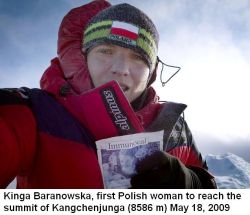
Kinga Baranowska, first Polish woman to reach the summit of Kangchenjunga.

On 18th of May Kinga Baranowska as the first Polish woman (Alpinus Expedition Team, KW Warsaw) summited Kangchenjunga (8586 m) which is located in Nepal.

Kangchenjunga have been summited in high winds – however, descent on Kang is reportedly very difficult.

Kinga’s Summits :

Cho Oyu (8201 m) – October , 2003 ;

Broad Peak (8047 m) – Julay 22, 2006 – The 11 woman ascent;

Nanga Parbat (8125 m) Julay 18, 2007

Dhaulagiri (8167 m) May 01, 2008 – first Polish woman

Manaslu (8156 m) October 5, 2008 – first Polish woman

Kangchenjunga (8586 m) May 18, 2009 – first Polish woman

* Official site : – http://www.kingabaranowska.com/

** – all my post, select category : – Kinga Baranowska

Kinga Baranowska, first Polish woman to reach the summit of Kangchenjunga.

Kinga’s Summits :

Cho Oyu (8201 m) – October , 2003 ;

Broad Peak (8047 m) – Julay 22, 2006 – The 11 woman ascent;

Nanga Parbat (8125 m) Julay 18, 2007

Dhaulagiri (8167 m) May 01, 2008 – first Polish woman

Manaslu (8156 m) October 5, 2008 – first Polish woman

Kangchenjunga 8586 m) May 18, 2009 – first Polish woman

Chronicles of the expedition, part 10.

Kinga Baranowska, first Polish woman to reach the summit of Kangchenjunga.

On 18th of May Kinga Baranowska as the first Polish woman (Alpinus Expedition Team, KW Warsaw) summited Kangchenjunga (8586 m) which is located in Nepal.

Kangchenjunga have been summited in high winds – however, descent on Kang is reportedly very difficult.

Details are also expected on the summiteers’ safe return in C4.

Baranowska Kangch_2009 05.05 Fundacja Wspierania Alpinizmu_1

* Official site : – http://www.kingabaranowska.com/

** – all my post, select category : – Kinga Baranowska

Kinga Baranowska pierwszą Polką, która zdobyła Kanczendzonge.

18 Maja 2009 Kinga Baranowska (Alpinus Expedition Team, KW Warszawa) stanęła, jako pierwsza Polka na szczycie Kangchenjunga 8586 m) położonym w Nepalu.

Kronika wyprawy cz.10.

Relacja – Kinga Baranowska:

Jestem po. Na szczycie stanęłam późno, Góra niewyobrażalnie trudna i wymagająca, dla mnie najtrudniejsza ze wszystkich, na których do tej pory byłam. Jestem ekstremalnie zmęczona, straciłam tez głos od zimnego wiatru, ale tez szczęśliwa. Czeka mnie jeszcze trudne zejście do bazy z obozu IV. Górę tą dedykuje Wandzie Rutkiewicz. Więcej informacji jak zejdę do bazy.

18.05.2009

Jej atak odbywał się w grupie blisko 20 himalaistów z całego świata – głównie z Hiszpanii. Szturmowy obóz IV na wysokości 7700 m Kinga opuściła 30 minut po północy. A szczyt zdobyła po 16 godzinach wspinaczki o godz. 16.45. W ataku szczytowym towarzyszył jej Juanjo Garra. Kinga jest już bezpieczna w obozie 4.

Atak szczytowy odbywał się w bardzo trudnych warunkach, w potwornym wietrze i pyłówkach, a do czwórki szli w śniegu po kolana.

Kinga jest pierwszą Polką na szczycie Kangchenjungi, jest też również czwartą kobietą, która zdobyła tę trudną górę. Kangchenjunga należy do tzw. wysokich ośmiotysięczników, a trudności w kopule szczytowej sięgają II i III stopnia trudności.

Kindze udało się to co nie udało się Wandzie Rutkiewicz, która zginęła 17 lat temu właśnie chcąc zdobyć szczyt Kangchenjungi.

* posty o wyprawach Kingi na mojej stronie kliknij : Kinga Baranowska

Wkrótce album zdjęć z wyprawy – zapraszam.

** poprzednie posty :

- Kangchenjunga Expedition 2009 – wyprawa Kingi Baranowskiej cz.9.

- Kangchenjunga Expedition 2009 – wyprawa Kingi Baranowskiej cz.8.

- Kangchenjunga Expedition 2009 – wyprawa Kingi Baranowskiej cz.7.

- Kangchenjunga Expedition 2009 – wyprawa Kingi Baranowskiej cz.6.

- Kangchenjunga Expedition 2009 – wyprawa Kingi Baranowskiej cz.5.

- Kangchenjunga Expedition 2009 – wyprawa Kingi Baranowskiej cz.4.

- Kangchenjunga Expedition 2009 – wyprawa Kingi Baranowskiej cz.3.

- Kangchenjunga Expedition 2009 – wyprawa Kingi Baranowskiej cz.2.

- Kangchenjunga Expedition 2009 – wyprawa Kingi Baranowskiej cz.1.

- Polish Himalaya Expeditions 2009 part 4. Himalaje 2009 – polskie wyprawy, cz. 4. /Version english and polish/

- video – Kinga Baranowska w Kathmandu Kangch 2009

Kangch Expedition 2009 sponsor

Sponsorzy wyprawy.

goryonline.com

** zapraszam na relacje z wypraw polskich himalaistów.

Polish Himalaya Expeditions 2009 part 6.

Kangchenjunga 2009 Expedition led by Kinga Baranowska.

Goal:

Kinga Baranowska wants to climb Kangchenjunga (8598 m) by normal (first ascent) route. kinga-z-lina_150

Accomplishment time:

01.04.2009 – 30.05.2009

Description of the expedition:

The team wants to climb Kangchenjunga (8598 m) by normal route. Polish Kinga Baranowska is attempting Kangchenjunga, as member in K2 Magic Line leader Oscar Cadiach’s Spanish team.

Kinga’s first 8000er was Cho Oyu in 2002. She topped-out Broad Peak in 2004, Nanga Parbat in 2007 and, last year, Dhaulagiri and Manaslu.

Kinga Baranowska hopes to turn Kangchenjunga into her 6th 8000er.

kang-recorregut_cb-cimFot. Ferran Latorre

kang-recorregut_c2-cimFot. Ferran Latorre

Kangchenjunga 2009 Expedition – in review :

Kinga Baranowska and team are back from their last trip to C3. They’re now acclimatized and ready to launch a summit push.

* Previous story :

- Polish Himalaya Expeditions 2009 part 4. Himalaje 2009 – polskie wyprawy, cz. 4. /Version english and polish/

Dhaulagiri Expedition 2009 led by Anna Czerwińska.

dhaulagiri-new1

Dhaulagiri Expedition 2009 led by Anna Czerwińska ( The first Polish woman to reach the 7 Summits. ) ; the team : Ola Ihnatowicz, Justyna Szepieniec, Zbigniew Bąk, Dariusz Jasiński.

Goal:

The team wants to climb Dhaulagiri [8167] by normal route.

Accomplishment time:

17.03.2009 – 30.04.2009

Description of the expedition:

aniawgorach.jpgThe team wants to climb the mountain by normal route.
Dhaulagiri (8,167 metres -26,795 ft) can be translated as “White Mountain” and is situated in the western part of Kali Gandaki valley, about 33 kilometres from neighbouring Annapurna. It is the seventh highest mountain in the world, first climbed in 1960 by Kurt Diemberger, Ernst Forrer, Albin Schabert and sherps: Nim Dorjee and Nawang Dorjee.

# 1985 A Polish expedition including the famed Jerzy Kukuczka climbs Dhaulagiri, via the standard route, in winter – first winter summit: they reach the summit on January 21.
# 1986 A mostly Polish expedition puts up the second South Face route, on the left side of the face, connecting with the Southwest Ridge route. They go above 7500 m but do not reach the summit.

Dhaulagiri Expedition 2009 – in review.

Anna Czerwińska and team are back from their last trip to C3. They’re now acclimatized and ready to launch a summit push.

* Previous story :

- Polish Himalaya Expeditions 2009 part 3. Himalaje 2009 – polskie wyprawy, cz. 3. /Version english and polish/

Polish Tatra Rescuers Expedition 100 years of TOPR .baner_topr-dhaulagiri

TOPR – Dhaulagiri Expedition 2009 led by Ryszard Gajewski (Manaslu -8156 m n.p.m. – first winter summit), the team : Andrzej Mikler, Edward Lichota, Grzegorz Bargiel, Maciej Pawlikowski, Roman Mazik, Tomasz Witkowski.

Goal:

The team wants to climb Dhaulagiri [8167] by normal route and north-west wall [by japanese route].

dhaulagiri-wielicki-new* red – normal route ; * green – Japanese route.

Accomplishment time:

23.03.2009 – 14.05.2009

Description of the expedition:

blogtopr The team wants to climb the mountain by normal route and north-west wall [by japanese route].
Dhaulagiri (8,167 metres -26,795 ft) can be translated as “White Mountain” and is situated in the western part of Kali Gandaki valley, about 33 kilometres from neighbouring Annapurna. It is the seventh highest mountain in the world, first climbed in 1960 by Kurt Diemberger, Ernst Forrer, Albin Schabert and sherps: Nim Dorjee and Nawang Dorjee.

# 1985 A Polish expedition including the famed Jerzy Kukuczka climbs Dhaulagiri, via the standard route, in winter – first winter summit: they reach the summit on January 21.
# 1986 A mostly Polish expedition puts up the second South Face route, on the left side of the face, connecting with the Southwest Ridge route. They go above 7500 m but do not reach the summit.

TOPR – Dhaulagiri Expedition 2009 - in review :

Himalaya wrap-up: over on Dhaulagiri.

2009, May 02.

Dhaulagiri – it’s over

Expedition member Tomasz Witkowski writes today on the Dhaulagiri – TOPR website that forecasts show no chance of a window before May 14, the end of accomplishment time. They organizing porters and BC is packed up.

* Previous story :

- Polish Himalaya Expeditions 2009 part 2. Himalaje 2009 – polskie wyprawy, cz. 2. /Version english and polish/

Himalaje 2009 – polskie wyprawy, cz. 6.

KINGA BARANOWSKA RUSZA NA KANCZENDZONGĘ (8586 M).

Cel:

Celem wyprawy Kingi jest wspinaczka na Kanczendzongę (8598 m) – trzeci najwyższy szczyt świata.

Termin realizacji :

Wspinaczka planowana jest od początku kwietnia do końca maja.

Opis wyprawy:

Wejście na szczyt jest przewidziane ścianą południowo-zachodnią (tzw. drogą brytyjską – normalną). Na zdjęciach poniżej pokazano drogę na szczyt.

kang-recorregut_cb-cimFot. Ferran Latorre

kang-recorregut_c2-cimFot. Ferran Latorre

Relacje z wyprawy Kangchenjunga Expedition 2009.

Kinga Baranowska zakończyła swoje ostatnie wyjście do obozu III i teraz odpoczywa w bazie. Będąc cały dzień w obozie III chciała razem z Alberto, by wyjść w stronę obozu IV (ok. 7700 m), ale generalnie nie byli zbyt rześcy. Powyżej trójki tak bardzo wieje, że ledwo co widać, więc zrezygnowali z tego wyjścia i wrócili do bazy.

* poprzednie posty o tej wyprawie :

- Kangchenjunga Expedition 2009 – wyprawa Kingi Baranowskiej cz.7.

- Kangchenjunga Expedition 2009 – wyprawa Kingi Baranowskiej cz.6.

- Kangchenjunga Expedition 2009 – wyprawa Kingi Baranowskiej cz.5.

- Kangchenjunga Expedition 2009 – wyprawa Kingi Baranowskiej cz.4.

- Kangchenjunga Expedition 2009 – wyprawa Kingi Baranowskiej cz.3.

- Kangchenjunga Expedition 2009 – wyprawa Kingi Baranowskiej cz.2.

- Kangchenjunga Expedition 2009 – wyprawa Kingi Baranowskiej cz.1.

Dhaulagiri Expedition 2009 – wyprawa Anny Czerwińskiej.

Cel:

Celem wyprawy jest wejście na szczyt Dhaulaghiri (8167 m) drogą od strony północno-wschodniej.

Zespół :

Udział w wyprawie biorą : Anna Czerwińska, Ola Ihnatowicz, Justyna Szepieniec, Zbigniew Bąk, Dariusz Jasiński.

dhaulagiri-new

Dhaulagiri to siódmy szczyt Ziemi, wznoszący się na wysokość 8167 m n.p.m.

Relacje z wyprawy Dhaulagiri Expedition 2009.

Po nieudanej próbie ataku na szczyt Justyny Szepieniec, zrezygnowała ona z wyprawy 02.05.2009, a jako powód podała kolejną tragedie na Dhaulagiri czyli zaginięcie Irańczyka Mehdi. Od kilku dni brak jest innych informacji od tej wyprawy.

* poprzednie posty o tej wyprawie :

- Dhaulagiri Expedition 2009 – wyprawa Anny Czerwińskiej cz.6.

- Dhaulagiri Expedition 2009 – wyprawa Anny Czerwińskiej cz.5.

- Dhaulagiri Expedition 2009 – wyprawa Anny Czerwińskiej cz.4.

- Dhaulagiri Expedition 2009 – wyprawa Anny Czerwińskiej cz.3.

- Dhaulagiri Expedition 2009 – wyprawa Anny Czerwińskiej cz.2.

- Dhaulagiri Expedition 2009 – wyprawa Anny Czerwińskiej cz.1.

Polska Wyprawa Ratowników 100 lecie TOPR – DHAULAGIRI 2009.baner_topr-dhaulagiri

Cel:

Celem jest jest zdobycie ośmiotysięcznika Dhaulagiri, a ponadto ratownicy chcą uczcić setną rocznicę powstania TOPR oraz przypomnieć udział Polaków w zdobywaniu tej góry.

“Na Dhaulagiri zamierzamy wchodzić dwoma drogami. Tzw. “stara kadra” będzie wspinać się drogą normalną, a młodzi pójdą na ścianę północną tzw. Drogą Japońską “przez gruszkę” – objaśnia taktykę kierownik wyprawy.

dhaulagiri-wielicki-new

Relacje z wyprawy TOPR – DHAULAGIRI 2009.

Wyprawa TOPR na Dhaulagiri został zakończona, a oto jak do tego doszło.

Sobota 2009-05-02

Koniec wyprawy.

Kolejne dni działalności na Dhaulagiri nie przyniosły korzystnych rozstrzygnięć. W obozie drugim rozchorował się E.Lichota i zmuszony był zejść do bazy 27 kwietnia. W tym czasie R.Gajewski i M.Pawlikowski udali się z jedynki do obozu drugiego z zamiarem dojścia do trójki, którą mają założyć G.Bargiel i A.Mikler przebywający w obozie drugim.
W kolejnym dniu zespół z dwójki wychodzi w kierunku obozu trzeciego poręczując drogę do wysokości 7300m. Na miejsce tzw. dolnej trójki docierają na tyle zmęczeni, że nie są w stanie zakładać obozu i postanawiają schodzić na odpoczynek do bazy. Następnego dnia R.Gajewski i M.Pawlikowski podjęli próbę założenia obozu trzeciego. Niestety po dojściu do wysokości 7250m, nie udało się po raz kolejny założyć obozu trzeciego. Po czterodniowej działalności w górze zeszli do bazy pierwszego maja.

Z uwagi na prognozy pogody i margines czasu jaki pozostał nam na działalność nie planujemy już kolejnych wyjść i tym samym kończymy wyprawę. Piątego maja planujemy likwidację bazy i rozpoczęcie karawany powrotnej.
W Kathamndu będziemy ósmego maja wieczorem.

Tomasz Witkowski

* poprzednie posty o tej wyprawie :

- TOPR – DHAULAGIRI 2009. Polska Wyprawa Ratowników 100 lecie TOPR cz.8 – zakończenie wyprawy.

- TOPR – DHAULAGIRI 2009. Polska Wyprawa Ratowników 100 lecie TOPR cz.7.

- TOPR – DHAULAGIRI 2009. Polska Wyprawa Ratowników 100 lecie TOPR cz.6.

- TOPR – DHAULAGIRI 2009. Polska Wyprawa Ratowników 100 lecie TOPR cz.5.

- TOPR – DHAULAGIRI 2009. Polska Wyprawa Ratowników 100 lecie TOPR cz.4.

- TOPR – DHAULAGIRI 2009. Polska Wyprawa Ratowników 100 lecie TOPR cz.3.

- TOPR – DHAULAGIRI 2009. Polska Wyprawa Ratowników 100 lecie TOPR cz.2.

- TOPR – DHAULAGIRI 2009. Polska Wyprawa Ratowników 100 lecie TOPR cz.1.

** poprzednie posty :

- Polish Himalaya Expeditions 2009 part 5. Himalaje 2009 – polskie wyprawy, cz.5. /Version english and polish/

- Polish Himalaya Expeditions 2009 part 4. Himalaje 2009 – polskie wyprawy, cz. 4. /Version english and polish/

- Polish Himalaya Expeditions 2009 part 3. Himalaje 2009 – polskie wyprawy, cz. 3. /Version english and polish/

- Polish Himalaya Expeditions 2009 part 1. Himalaje 2009 – polskie wyprawy, cz. 1. /Version english and polish/

- Polish Himalaya Expeditions 2009 part 2. Himalaje 2009 – polskie wyprawy, cz. 2. /Version english and polish/

goryonline.com

** zapraszam na relacje z wypraw polskich himalaistów.

Polish Himalaya Expeditions 2009 part 5.

Kangchenjunga 2009 Expedition led by Kinga Baranowska.

Goal:

Kinga Baranowska wants to climb Kangchenjunga (8598 m) by normal (first ascent) route. kinga-z-lina_150

Accomplishment time:

01.04.2009 – 30.05.2009

Description of the expedition:

The team wants to climb Kangchenjunga (8598 m) by normal route. Polish Kinga Baranowska is attempting Kangchenjunga, as member in K2 Magic Line leader Oscar Cadiach’s Spanish team.

Kinga’s first 8000er was Cho Oyu in 2002. She topped-out Broad Peak in 2004, Nanga Parbat in 2007 and, last year, Dhaulagiri and Manaslu.

Kinga Baranowska hopes to turn Kangchenjunga into her 6th 8000er.

kang-recorregut_cb-cimFot. Ferran Latorre

kang-recorregut_c2-cimFot. Ferran Latorre

Kangchenjunga 2009 Expedition – in review :

Apr 22.2009 the members of the expedition together with the whole caravan reached a Base Camp -Yalung (5200m). Kinga was ill by next several day.

Now she and Oscar Cadiach’s team did a first trip up to C1.

** Previous story :

- Polish Himalaya Expeditions 2009 part 4. Himalaje 2009 – polskie wyprawy, cz. 4. /Version english and polish/

Dhaulagiri Expedition 2009 led by Anna Czerwińska.

dhaulagiri-new1

Dhaulagiri Expedition 2009 led by Anna Czerwińska ( The first Polish woman to reach the 7 Summits. ) ; the team : Ola Ihnatowicz, Justyna Szepieniec, Zbigniew Bąk, Dariusz Jasiński.

Goal:

The team wants to climb Dhaulagiri [8167] by normal route.

Accomplishment time:

17.03.2009 – 30.04.2009

Description of the expedition:

aniawgorach.jpgThe team wants to climb the mountain by normal route.
Dhaulagiri (8,167 metres -26,795 ft) can be translated as “White Mountain” and is situated in the western part of Kali Gandaki valley, about 33 kilometres from neighbouring Annapurna. It is the seventh highest mountain in the world, first climbed in 1960 by Kurt Diemberger, Ernst Forrer, Albin Schabert and sherps: Nim Dorjee and Nawang Dorjee.

# 1985 A Polish expedition including the famed Jerzy Kukuczka climbs Dhaulagiri, via the standard route, in winter – first winter summit: they reach the summit on January 21.
# 1986 A mostly Polish expedition puts up the second South Face route, on the left side of the face, connecting with the Southwest Ridge route. They go above 7500 m but do not reach the summit.

Dhaulagiri Expedition 2009 – in review.

The Anna Czerwińska team reported strong winds and tough sections of crystal ice between C2 and C3, which forced the climbers to fix a large amount of rope.

** Previous story :

- Polish Himalaya Expeditions 2009 part 3. Himalaje 2009 – polskie wyprawy, cz. 3. /Version english and polish/

Polish Tatra Rescuers Expedition 100 years of TOPR .baner_topr-dhaulagiri

TOPR – Dhaulagiri Expedition 2009 led by Ryszard Gajewski (Manaslu -8156 m n.p.m. – first winter summit), the team : Andrzej Mikler, Edward Lichota, Grzegorz Bargiel, Maciej Pawlikowski, Roman Mazik, Tomasz Witkowski.

Goal:

The team wants to climb Dhaulagiri [8167] by normal route and north-west wall [by japanese route].

dhaulagiri-wielicki-new* red – normal route ; * green – Japanese route.

Accomplishment time:

23.03.2009 – 14.05.2009

Description of the expedition:

blogtopr The team wants to climb the mountain by normal route and north-west wall [by japanese route].
Dhaulagiri (8,167 metres -26,795 ft) can be translated as “White Mountain” and is situated in the western part of Kali Gandaki valley, about 33 kilometres from neighbouring Annapurna. It is the seventh highest mountain in the world, first climbed in 1960 by Kurt Diemberger, Ernst Forrer, Albin Schabert and sherps: Nim Dorjee and Nawang Dorjee.

# 1985 A Polish expedition including the famed Jerzy Kukuczka climbs Dhaulagiri, via the standard route, in winter – first winter summit: they reach the summit on January 21.
# 1986 A mostly Polish expedition puts up the second South Face route, on the left side of the face, connecting with the Southwest Ridge route. They go above 7500 m but do not reach the summit.

TOPR – Dhaulagiri Expedition 2009 - in review :

The Polish team of Tatra Mountain rescuers reported strong winds and tough sections of crystal ice between C2 and C3, which forced the climbers to fix a large amount of rope.

** Previous story :

- Polish Himalaya Expeditions 2009 part 2. Himalaje 2009 – polskie wyprawy, cz. 2. /Version english and polish/

Himalaje 2009 – polskie wyprawy, cz. 5.

KINGA BARANOWSKA RUSZA NA KANCZENDZONGĘ (8586 M).

Cel:

Celem wyprawy Kingi jest wspinaczka na Kanczendzongę (8598 m) – trzeci najwyższy szczyt świata.

Termin realizacji :

Wspinaczka planowana jest od początku kwietnia do końca maja.

Opis wyprawy:

Wejście na szczyt jest przewidziane ścianą południowo-zachodnią (tzw. drogą brytyjską – normalną). Na zdjęciach poniżej pokazano drogę na szczyt.

kang-recorregut_cb-cimFot. Ferran Latorre

kang-recorregut_c2-cimFot. Ferran Latorre

Relacje z wyprawy Kangchenjunga Expedition 2009.

Kinga Baranowska zakończyła długi domarsz pod Kangchendzöngę. W dniu 22 kwietnia karawana dotarła do bazy na lodowcu Yalung (5200m).

Pierwsze dni w bazie Kinga spędziła na kuracji – dokuczał jej ostry kaszel i musiała korzystać z pomocy lekarza: Czwarty dzień brania antybiotyku. Dziś zbada mnie ponownie lekarz i zadecyduje, jak będzie przebiegać dalsza kuracja – pisała 24 kwietnia na swojej stronie.

Teraz wraz z zespołem Oscar Cadiach’s team będzie wspinała się do C1.

* poprzednie posty o tej wyprawie :

- Kangchenjunga Expedition 2009 – wyprawa Kingi Baranowskiej cz.4.

- Kangchenjunga Expedition 2009 – wyprawa Kingi Baranowskiej cz.3.

- Kangchenjunga Expedition 2009 – wyprawa Kingi Baranowskiej cz.2.

- Kangchenjunga Expedition 2009 – wyprawa Kingi Baranowskiej cz.1.

Dhaulagiri Expedition 2009 – wyprawa Anny Czerwińskiej.

Cel:

Celem wyprawy jest wejście na szczyt Dhaulaghiri (8167 m) drogą od strony północno-wschodniej.

Zespół :

Udział w wyprawie biorą : Anna Czerwińska, Ola Ihnatowicz, Justyna Szepieniec, Zbigniew Bąk, Dariusz Jasiński.

dhaulagiri-new

Dhaulagiri to siódmy szczyt Ziemi, wznoszący się na wysokość 8167 m n.p.m.

Relacje z wyprawy Dhaulagiri Expedition 2009.

Wyprawa Anny czerwińskiej ma te same kłopoty z pogodą co wyprawa TOPR, czyli walka z wiatrem i opadami śniegu. Mimo takich warunków w dniu 27.04.2009 nadeszła wiadomość, że Justyna Szepieniec ma zamiar podjąć próbę ataku szczytowego…. niestety nie ma jeszcze info jak przebiegała ta akcja górska.

* poprzednie posty o tej wyprawie :

- Dhaulagiri Expedition 2009 – wyprawa Anny Czerwińskiej cz.5.

- Dhaulagiri Expedition 2009 – wyprawa Anny Czerwińskiej cz.4.

- Dhaulagiri Expedition 2009 – wyprawa Anny Czerwińskiej cz.3.

- Dhaulagiri Expedition 2009 – wyprawa Anny Czerwińskiej cz.2.

- Dhaulagiri Expedition 2009 – wyprawa Anny Czerwińskiej cz.1.

Polska Wyprawa Ratowników 100 lecie TOPR – DHAULAGIRI 2009.baner_topr-dhaulagiri

Cel:

Celem jest jest zdobycie ośmiotysięcznika Dhaulagiri, a ponadto ratownicy chcą uczcić setną rocznicę powstania TOPR oraz przypomnieć udział Polaków w zdobywaniu tej góry.

“Na Dhaulagiri zamierzamy wchodzić dwoma drogami. Tzw. “stara kadra” będzie wspinać się drogą normalną, a młodzi pójdą na ścianę północną tzw. Drogą Japońską “przez gruszkę” – objaśnia taktykę kierownik wyprawy.

dhaulagiri-wielicki-new

Relacje z wyprawy TOPR – DHAULAGIRI 2009.

Wyprawa TOPR na Dhaulagiri, po założeniu w dniu 15 kwietnia obozu II (6650m), nie odnotowała dalszych postępów. Na przeszkodzie stają opady śniegu i silny wiatr.

Trudności w drodze do obozu trzeciego są większe niż zwykle ponieważ mała ilość opadów śniegu i silne wiatry zamieniają śnieżna grań w lodową. Duża ilość lodu wymusza zakładanie poręczówek na całej trasie w kierunku trójki.

* poprzednie posty o tej wyprawie :

- TOPR – DHAULAGIRI 2009. Polska Wyprawa Ratowników 100 lecie TOPR cz.7.

- TOPR – DHAULAGIRI 2009. Polska Wyprawa Ratowników 100 lecie TOPR cz.6.

- TOPR – DHAULAGIRI 2009. Polska Wyprawa Ratowników 100 lecie TOPR cz.5.

- TOPR – DHAULAGIRI 2009. Polska Wyprawa Ratowników 100 lecie TOPR cz.4.

- TOPR – DHAULAGIRI 2009. Polska Wyprawa Ratowników 100 lecie TOPR cz.3.

- TOPR – DHAULAGIRI 2009. Polska Wyprawa Ratowników 100 lecie TOPR cz.2.

- TOPR – DHAULAGIRI 2009. Polska Wyprawa Ratowników 100 lecie TOPR cz.1.

** poprzednie posty :

- Polish Himalaya Expeditions 2009 part 4. Himalaje 2009 – polskie wyprawy, cz. 4. /Version english and polish/

- Polish Himalaya Expeditions 2009 part 3. Himalaje 2009 – polskie wyprawy, cz. 3. /Version english and polish/

- Polish Himalaya Expeditions 2009 part 1. Himalaje 2009 – polskie wyprawy, cz. 1. /Version english and polish/

- Polish Himalaya Expeditions 2009 part 2. Himalaje 2009 – polskie wyprawy, cz. 2. /Version english and polish/

goryonline.com

gieldaturystyki.pl

** zapraszam na relacje z wypraw polskich himalaistów.

Sociofluid

Promote cool website

Climbing courses and training - PZA Climbing Center in Tatras
One of best website about Mt Everest
www.Everest1953.co.uk
You can help

Trekking agency

advertise on blog

MY Favorite books...


    Polish Himalayas on Facebook

    Great tops for everyone!

    Mountaineering is my hobby and profession of walking, hiking, trekking and climbing up mountains. It is also sometimes known as alpinism, particularly in Europe.

    Picasa Web Albums

    Himalman's Weblog