Trekking Tours

Posted by Author On 5/29/2009

POST-SUMMARY-HERE

Everest, Everest History, Everest Firsts

Posted by Author On 5/29/2009

POST-SUMMARY-HERE

Expedition, expedition list, expeditions on 8000m peaks

Posted by Author On 5/29/2009

POST-SUMMARY-HERE

Showing posts with label summit. Show all posts

Everest legend Edmund Hillary. /Version english and polish/

Posted by himalman On 6/25/2009 11:28:00 am 1 comments

Everest legend Edmund Hillary has died at the age of 88.

This is a big loss to the world of exploration, Hillary’s family and also to Himalaya chronicler Elizabeth Hawley, 83, who remained one of Hillary’s closest friends since his great Everest ascent.

Edmund Hillary has passed away, taking a big chunk of Everest history with him.

Sir Edmund Percival Hillary
,(July 20, 1919January 11, 2008) was a New Zealand mountaineer and explorer. On 29 May 1953 at the age of 33, he and Sherpa mountaineer Tenzing Norgay became the first climbers known to have reached the summit of Mount Everest. They were part of the ninth British expedition to Everest, led by John Hunt.
Hillary was part of a British reconnaissance expedition to Everest in 1951 led by Eric Shipton before joining the successful British attempt of 1953.

In 1952 Hillary and George Lowe were part of the British team led by Eric Shipton that attempted Cho Oyu. After that attempt failed due to the lack of route from the Nepal side, Hillary and Lowe crossed the Lho-La into Tibet and reached the old Camp II, on the northern side, where all the pre-war expeditions camped.

After Everest :Hillary climbed ten other peaks in the Himalayas on further visits in 1956, 1960–61Edmund Hillary in 1957 after accompanying the first plane to land at the Marble Point ground air strip, Antarctica and 1963–65. He also reached the South Pole as part of the Commonwealth Trans-Antarctic Expedition, for which he led the New Zealand section, on 4 January 1958. His party was the first to reach the Pole overland since Amundsen in 1911 and Scott in 1912, and the first ever to do so using motor vehicles. In 1977, he led a jetboat expedition, titled “Ocean to Sky”, from the mouth of the Ganges River to its source.

In 1979, as he had done previously, Hillary was scheduled to act as a commentator on the ill-fated Air New Zealand Flight 901, an Antarctic sightseeing flight, but had to pull out due to work commitments elsewhere. He was replaced by his close friend Peter Mulgrew, who perished as the aircraft crashed on Mount Erebus, killing all 257 on board. He later married Mulgrew’s widow.

Hillary took part in the 1975 general election, as a member of the “Citizens for Rowling” campaign. His involvement in this campaign was seen as precluding his nomination as Governor-General, with the position instead being offered to Keith Holyoake in 1977. However, in 1985 he was appointed New Zealand High Commissioner to India (concurrently High Commissioner to Bangladesh and Ambassador to Nepal) and spent four and a half years based in New Delhi.

In 1985 he accompanied Neil Armstrong in a small twin-engined ski plane over the Arctic Ocean and landed at the North Pole. He thus became the first man to stand at both poles and on the summit of Everest.

In January 2007, Hillary travelled to Antarctica to commemorate the 50th anniversary of the founding of Scott Base. He flew to the station on 18 January 2007 with a delegation including the Prime Minister. While there he called for the British government to contribute to the upkeep of Scott’s and Shackleton’s huts.

On 22 April 2007 while on a trip to Kathmandu he is reported to have suffered a fall. There was no comment on the nature of his illness and he did not immediately seek treatment. He was hospitalized after returning to New Zealand.

Philanthropy

Following his ascent of Everest he devoted much of his life to helping the Sherpa people of Nepal through the Himalayan Trust, which he founded. Through his efforts many schools and hospitals were built in this remote region of the Himalayas. He was the Honorary President of the American Himalayan Foundation, a United States non-profit body that helps improve the ecology and living conditions in the Himalayas.

Hillary spoke of his disdain for the attitudes displayed by many modern mountaineers. In particular he publicly criticized New Zealander Mark Inglis and 40 other climbers who, in various groups, left British climber David Sharp to die in May 2006. He said:

I think the whole attitude towards climbing Mount Everest has become rather horrifying. The people just want to get to the top, it was wrong if there was a man suffering altitude problems and was huddled under a rock, just to lift your hat, say good morning and pass on by.

He also told the New Zealand Herald that he was horrified by the callous attitude of today’s climbers:

They don’t give a damn for anybody else who may be in distress and it doesn’t impress me at all that they leave someone lying under a rock to die.

I invite on viewing of gallery of photo…. Discovering Mt Everest with photos from expedition from 1953 -year - Edmund Hillary summit Everest : Album - Summit of Mt. Everst

Edmund Hillary, nowozelandzki himalaista, który przeszedł do historii jako pierwszy zdobywca Mount Everest, zmarł w piątek 11 stycznia 2008 w wieku 88 lat - powiadomiła ze smutkiem premier Nowej Zelandii Helen Clark.
Legendarny alpinista, poszukiwacz przygód i filantrop był najbardziej znanym Nowozelandczykiem, jaki kiedykolwiek żył - oznajmiła Clark.

Edmund Hillary dokonał pionierskiego wejścia na Mount Everest wraz z Szerpą Tenzingiem Norgayem 29 maja 1953 r. “Załatwiliśmy skurczybyka” powiedział do towarzyszy eskapady po zejściu ze szczytu, a dzięki relacji BBC słowa te usłyszał cały świat. W szeregu wielkich poszukiwaczy przygód stawiają go również inne wyczyny: zdobył m.in. oba bieguny i pokonał łodzią motorową rzekę Ganges od jej ujścia aż do źródeł.

Hillary znany był również ze swej działalności filantropijnej, która koncentrowała się wokół założonego przez niego funduszu powierniczego Himalayan Trust, prowadzącego akcje pomocy dla Szerpów.

Pośród licznych wyróżnień, Hillary miał na swym koncie również Krzyż Komandorski Orderu Zasługi Rzeczypospolitej Polskiej, którym w 2004 r. odznaczył go prezydent Aleksander Kwaśniewski.
Sir Edmund Percival Hillary (ur. 20 lipca 1919 w Tuakau koło Auckland, zm. 11 stycznia 2008 w Auckland) – nowozelandzki himalaista i polarnik, z zawodu pszczelarz.

W latach 1951-1952 uczestnik trzech wypraw himalajskich. 29 maja 1953 zdobył, jako pierwszy człowiek w historii, wraz z Szerpą Tenzingiem Norgayem, szczyt Mount Everest (8850 m).

Do historii przeszły jego słowa “Załatwiliśmy skurczybyka!” (We finally knocked the bastard off.) - wypowiedziane po zejściu ze szczytu Everestu. Nie przypuszczał nawet, że za pośrednictwem BBC usłyszał je cały świat.

Za swój wyczyn został uhonorowany przez królową angielską Elżbietę II tytułem szlacheckim. Natomiast Nowa Zelandia umieściła podobiznę Hillary’ego na pięciodolarowym banknocie. Był pierwszą osobą umieszczoną na banknocie za życia.

W 1954-1967 r. kierował wyprawami nowozelandzkimi w Himalaje i na Antarktydę. W trakcie ekspedycji zorganizowanej w ramach Międzynarodowego Roku Geofizyki (1955-1958) dotarł 3 stycznia 1958 r. do bieguna południowego i przeszedł w poprzek Antarktydę. Następnie przeszedł do nowozelandzkiej służby dyplomatycznej, którą pełnił do 1989 r.

W 1960 r. założył fundusz powierniczy - Himalayan Trust, który prowadzi akcje pomocy dla Szerpów. Dzięki działalności funduszu w himalajskich wioskach wybudowano dla Szerpów 27 szkół, 2 szpitale, 12 ośrodków zdrowia, mosty, wodociągi, a nawet małe lotniska.

Został honorowym obywatelem Nepalu. Tam też zginęła jego żona.

Podczas wizyty w Polsce w czerwcu 2004 r. został odznaczony przez Prezydenta RP Aleksandra Kwaśniewskiego Krzyżem Komandorskim Orderu Zasługi Rzeczypospolitej Polskiej.

Edmund Hillary jest autorem licznych książek m.in. The Ascent of Everest, High Adventure (1955), Schoolhouse in the Clouds (1965), autobiografii Nothing Venture, Nothing Win (1975), From the Ocean to the Sky (1979).

Zmarł wskutek niewydolności serca, w piątek 11 stycznia 2008, ok. godz. 9 czasu nowozelandzkiego, w szpitalu w Auckland. Informacja o jego śmierci została podana publicznie przez premiera Nowej Zelandii ok. godz. 11:20.

* zobacz : Album - Zdobywanie Mt. Everst


goryonline.com


* zapraszam do subskrypcji mojego bloga :

AddThis Feed Button

** zapraszam na relacje z wypraw polskich himalaistów.

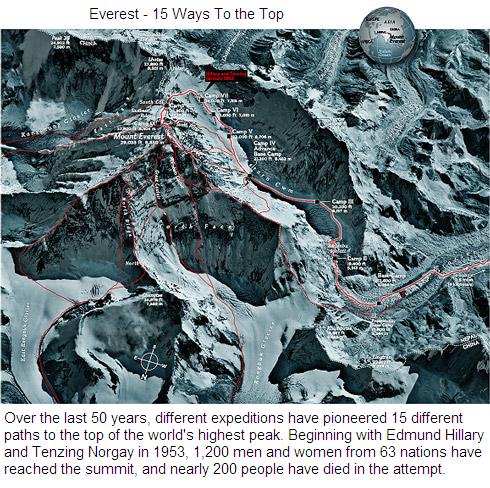
Routes to summit Mount Everest.

Posted by himalman On 6/17/2009 06:41:00 am 0 comments

From 1921 to 1938 all the British attempts were made via the North Col - North East Ridge route from Tibet. After the Second World War all routes to Mount Everest were forbidden and closed. In 1951 China occupied Tibet, the Chinese stopped all foreign travellers from gaining access to Everest from the traditional route. The British turned there sights to the South Side in Nepal. Permission was granted, which eventually led to the successful 1953 Expedition.

Today, you can reach Mount Everest from both Tibet and Nepal. They both welcome climbers and visitors from all over the world.

Mount Everest, also called Chomolungma or Qomolangma or Sagarmatha (Nepali: सगरमाथा) is the highest mountain on Earth, as measured by the height of its summit above sea level, which is 8,848 meters or 29,028 feet. The mountain, which is part of the Himalaya range in High Asia, is located on the border between Nepal and Tibet. By the end of the 2007 climbing season there had been 3,679 ascents to the summit by 2,436 individuals. There have been 210 deaths on the mountain, where conditions are so difficult that most corpses have been left where they fell; some are visible from standard climbing routes.[4]

Climbers range from experienced mountaineers to relative novices who count on their paid guides to get them to the top. This means climbers are a significant source of tourist revenue for Nepal, whose government also requires all prospective climbers to obtain an expensive permit, costing up to $25,000 (USD) per person.[5]

1. Routes of Mt Everest part 1. Drogi na szczyt Mt. Everest cz.1. /Version english and polish/

2. Routes of Mt Everest part 2. Drogi na szczyt Mt. Everest cz.2. /Version english and polish/

3. Routes of Mt Everest part 3. Drogi na szczyt Mt. Everest cz.3. /Version english and polish/

4. Routes of Mt Everest part 4. Drogi na szczyt Mt. Everest cz.4. /Version english and polish/

5. Routes of Mt Everest part 5. Drogi na szczyt Mt. Everest cz.5. /Version english and polish/

6. Routes of Mt Everest part 6. Drogi na szczyt Mt. Everest cz.6. /Version english and polish/

7. Routes of Mt Everest part 7. Drogi na szczyt Mt. Everest cz.7. /Version english and polish/

1everest routes map Routes to summit Mt. Everest.

1aerial routes Routes to summit Mt. Everest.

to see live this map click on : ChomolungmaNirvana-theRoutesofMountEverestMay292004.shtml

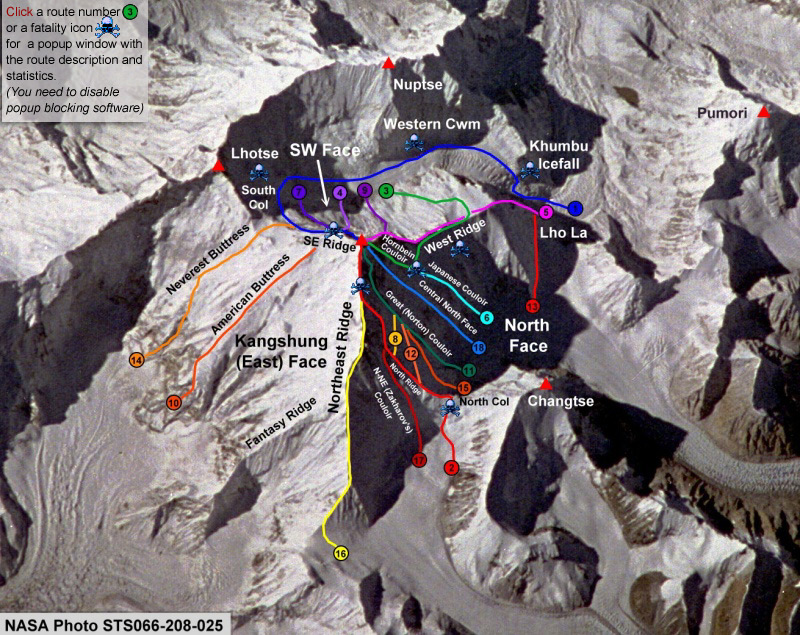
Pete Poston has created an outstanding map of all the routes on Mount Everest (including the Central North Face). Click the image to view larger, and then mouse over the route symbols and the fatality symbols for statistics (by AdventureStats).

But before you do, here's Pete's story:

Eighteen-fold Path to Chomolungma Nirvana – the Routes of Mount Everest

By Pete Poston for MountEverest.net

So you’ve decided that you want to climb Chomolungma, Goddess Mother of the World. As if climbing the mountain wasn’t hard enough, now you have to decide which route you want to take to the top, because the path to Everest-Nirvana follows not an eightfold path, but is at least eighteen-fold (see accompanying routes graphic)!

Depending on whether you are a professional climber mounting your own expedition, or an amateur considering joining a commercial outfit, the smart climber considers the objective dangers as part of their decision.

In this article we will consider each of these fifteen routes in terms of objective dangers, successful summits, and as morbid as it may sound, fatality rates as well.

The Buddhist practice of Right Association

If you want to be guided to the top in a commercial expedition, then you need to practice the Buddhist practice of right association. In our context, this means joining a reputable commercial outfit. In terms of routes followed by commercial expeditions, the choices are basically limited to either the traditional Western Cwm-Southeast Ridge (route 1), or the classic Mallory route to the top following the North Col-Northeast Ridge (route 2).

These are good choices for the safety conscious, because the routes are well-known, the objective dangers well understood, and there are plenty of guides available who have climbed them before, like Apa Sherpa who has summited via the Southeast Ridge a staggering fourteen times!

The normal routes - SE ridge vs NE ridge

According to AdventureStat.com statistics compiled through May of 2003, the Southeast Ridge has been climbed 1140 times, with 80 fatalities, for a fatality rate of 7% (fatality rate = fatalities/summits; and not all fatalities were summiters). The Northeast Ridge has been successfully climbed fewer times with 655 summits and 62 fatalities, resulting in a higher fatality rate of 9%.

The normal routes - dangers

In terms of objective dangers, the most dangerous part of the Southeast Ridge route is of course, the notorious Khumbu Icefall. Dangerous not only for climbers, but especially so for the Sherpa porters who must pass through it many times before the end of the climbing season. But the Lhotse Face has seen its fair share of fatalities as well, with perhaps the most preventable death that of Taiwanese climber Chen Yu Nan, who in 1996 fell into a crevasse while answering a call of nature -unroped and in down booties (he survived the fall but died while being helped down).

Beware of falling into hidden crevasses in the Western Cwm, too. Eight climbers have lost their lives in this manner, including Babu Chiri Sherpa, who fell into a hidden crevasse at Camp 2 in 2001.

On the North side, most deaths are from avalanches on the unstable snow slopes of the North Col, or in catastrophic falls from the Northeast Ridge down the terraced ledges of the Yellow Band (believed by many to be the probable fate of Mallory and Irvine).

The South Pillar

Another relatively safe route up Everest – if there really is such a thing as a “safe” route on Everest! – is the South Pillar (route 7), first climbed in 1980 by Polish super-alpinists Jerzy Kukuczka and Andrzej Czok.

The route has been climbed in it’s entirety a total of 17 times with one fatality. The Polish team spent 16 days establishing the route through the difficult rock barriers towards the top of the route, so many climbers opt to traverse across to the SE Ridge lower down.

28 climbers have traversed over from this route and safely summited. The one fatality that occurred on the complete S Pillar route was Josef Psotka in 1984, who after successfully summiting was killed in a fall, but it was from the Lhotse Face while descending the standard SE Ridge route. So to date there have been no fatalities on the South Pillar itself.

The South West Face

Turning our attention to the Southwest Face, there are two routes to consider, both extremely difficult, involving Class 5 climbing at extreme altitude.

The original Southwest Face route (route 4), first climbed by an expedition led by Chris Bonington in 1975, placed Dougal Haston and Doug Scott on the summit at sunset. They avoided freezing to death by huddling in a snow cave just below the South Summit.

A grand total of fifteen climbers have summited via the SW Face - with four fatalities - for a fatality rate of 27%.

Nearby is the West Pillar (route 9), first climbed in 1982 by a Russian expedition including Eduard Myslovski and Volodya Balyberdin. There were a total of eleven summits on this expedition, and thankfully no fatalities. The route has not been repeated.

The principle of Right Knowledge

Because of their difficulty, these Southwest Face - and the following routes we’re about to discuss - haven’t been climbed all that often, so from a purely statistical point of view, quoting fatality rates suffers from “undersampling” the “data”. This can cut both ways, so that a route that appears safe now can become a deathtrap later, or a route that presently has a high fatality rate can get statistically easier in the future. This is just another way of stating the Law of Averages.

So even though a particular route hasn’t resulted in any deaths to date, it seems highly likely that in the future there will be. But climbers understand the Law of Averages, because like Buddhists, they employ the principle of right knowledge.

The East Face; The Right Effort

Currently there are two successfully climbed routes on the East Face, the American Buttress (route 10 - or sometimes referred to as the Lowe Buttress), and the Neverest Buttress (route 14).

The American Buttress has been successfully climbed a total of six times, while the Neverest Buttress has seen a total of seven ascents by two different parties. No fatalities to date, and we applaud these climbers for following the Buddhist precept of right effort.

The NE Ridge; the Right Mindfulness

Other routes that don’t see many ascents are the complete Northeast Ridge (route 16) and Zakharov’s Couloir (route 17).

The complete NE Ridge was first attempted in 1982 by a team that included pre-eminent mountaineers Peter Boardman and Joe Tasker, who perished in the attempt.

It wasn’t until 1995 that success was achieved by a Japanese expedition led by Kiroshi Furuno. There have been a total of three fatalities on the route and six summits, for a fatality rate of 50%.

Future parties are advising to practice right mindfulness on this route. It’s a dangerous one, extended, very difficult, with prolonged time spent in the Death Zone. As for Zakharov’s Couloir, it has seen three ascents and no fatalities. Ironically, the leader Nikolai Zakharov had to turn back only fifteen minutes from the summit searching for a lost comrade, or else there would have been four summits.

The North Face and the West Ridge

And now for the most dangerous routes to the top. The routes on the North Face and West Ridge are the most notorious on the entire mountain.

White Limbo (route 11), a direct route up the Great Couloir, has seen two summits and one fatality, or a 50% fatality rate. It’s neighbor is the Japanese Couloir/Hornbein Couloir (route 6). Lots of fatalities on this route – four with only seven summits, so watch out, the fatality rate is a whopping 57%.

Another killer is the West Ridge Direct and it’s close cousin, the West Ridge/Hornbein Couloir (routes 5 and 3 respectively).

Fatalities 100%+

The West Ridge Direct route has more fatalities than deaths, so the fatality rate is actually over 100%. There have been ten summits but eleven fatalities, for a fatality rate of 110%.

Many of these deaths were descending the Hornbein Couloir, or in the catastrophic avalanche that killed five climbers on the West Shoulder in 1974, including Frenchman Gérard Devouassoux.

The West Ridge/Hornbein Couloir also has a fatality rate over 100%. Five climbers have summited, including Tom Hornbein and Willi Unsoeld who established the route in 1963, while nine have perished, for a fatality rate of 180%.

The most recent fatality was snowboarder Marco Siffredi of France, who ascended the standard NE Ridge, but disappeared attempting the first snowboard descent of the Hornbein Couloir. The crux of the route is a short step where the route exits the Yellow Band, and one has to wonder if this is where Marco met his fate.

Unclimbed

To wrap up, let’s not forget that there still are routes on Everest that have been attempted but haven’t been climbed yet, such as the Fantasy Ridge on the East Face. The most recent attempt was by Cathy O'Dowd in 2003, where an avalanche nearly wiped out the entire route including base camp.

And the Russians are currently attempting a new route on the North Face – the Central North Face Direct (route 18) - that lies between White Limbo and The Japanese Couloir. This ultimate directissima involves technical climbing at high altitude, with the crux section through the Yellow Band starting at over 8000 meters.

Right speech, right behavior, right absorption - and the right livelihood!

What further Buddhist practices are left as we follow the fifteen-fold path to Chomolungma Nirvana? Climbers should practice right speech (don’t yell at your sherpas!), right behavior (pick up your beer bottles, I mean oxygen bottles), and right absorption. And of course Everest climbers are all engaged in the right livelihood! May their puja ceremonies all be potent, and let’s pray that none get bitten by the Dogs of Chomolungma. Namaste.

References:
"Everest: Eighty Years of Triumph and Tragedy", Peter Gillman, ed., 2000
"Everest: The Mountaineering History", 3rd ed., Walt Unsworth, 2000

* Read these stories - and more! - at ExplorersWeb.com


* zapraszam do subskrypcji mojego bloga :

AddThis Feed Button

** zapraszam na relacje z wypraw polskich himalaistów.

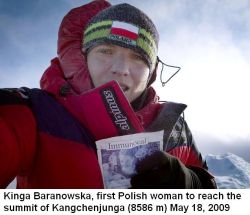
Kinga Baranowska, first Polish woman to reach the summit of Kangchenjunga.

Kinga’s Summits :

Cho Oyu (8201 m) – October , 2003 ;

Broad Peak (8047 m) – Julay 22, 2006 – The 11 woman ascent;

Nanga Parbat (8125 m) Julay 18, 2007

Dhaulagiri (8167 m) May 01, 2008 – first Polish woman

Manaslu (8156 m) October 5, 2008 – first Polish woman

Kangchenjunga 8586 m) May 18, 2009 – first Polish woman

Chronicles of the expedition, part 10.

Kinga Baranowska, first Polish woman to reach the summit of Kangchenjunga.

On 18th of May Kinga Baranowska as the first Polish woman (Alpinus Expedition Team, KW Warsaw) summited Kangchenjunga (8586 m) which is located in Nepal.

Kangchenjunga have been summited in high winds – however, descent on Kang is reportedly very difficult.

Details are also expected on the summiteers’ safe return in C4.

Baranowska Kangch_2009 05.05 Fundacja Wspierania Alpinizmu_1

* Official site : – http://www.kingabaranowska.com/

** – all my post, select category : – Kinga Baranowska

Kinga Baranowska pierwszą Polką, która zdobyła Kanczendzonge.

18 Maja 2009 Kinga Baranowska (Alpinus Expedition Team, KW Warszawa) stanęła, jako pierwsza Polka na szczycie Kangchenjunga 8586 m) położonym w Nepalu.

Kronika wyprawy cz.10.

Relacja – Kinga Baranowska:

Jestem po. Na szczycie stanęłam późno, Góra niewyobrażalnie trudna i wymagająca, dla mnie najtrudniejsza ze wszystkich, na których do tej pory byłam. Jestem ekstremalnie zmęczona, straciłam tez głos od zimnego wiatru, ale tez szczęśliwa. Czeka mnie jeszcze trudne zejście do bazy z obozu IV. Górę tą dedykuje Wandzie Rutkiewicz. Więcej informacji jak zejdę do bazy.

18.05.2009

Jej atak odbywał się w grupie blisko 20 himalaistów z całego świata – głównie z Hiszpanii. Szturmowy obóz IV na wysokości 7700 m Kinga opuściła 30 minut po północy. A szczyt zdobyła po 16 godzinach wspinaczki o godz. 16.45. W ataku szczytowym towarzyszył jej Juanjo Garra. Kinga jest już bezpieczna w obozie 4.

Atak szczytowy odbywał się w bardzo trudnych warunkach, w potwornym wietrze i pyłówkach, a do czwórki szli w śniegu po kolana.

Kinga jest pierwszą Polką na szczycie Kangchenjungi, jest też również czwartą kobietą, która zdobyła tę trudną górę. Kangchenjunga należy do tzw. wysokich ośmiotysięczników, a trudności w kopule szczytowej sięgają II i III stopnia trudności.

Kindze udało się to co nie udało się Wandzie Rutkiewicz, która zginęła 17 lat temu właśnie chcąc zdobyć szczyt Kangchenjungi.

* posty o wyprawach Kingi na mojej stronie kliknij : Kinga Baranowska

Wkrótce album zdjęć z wyprawy – zapraszam.

** poprzednie posty :

- Kangchenjunga Expedition 2009 – wyprawa Kingi Baranowskiej cz.9.

- Kangchenjunga Expedition 2009 – wyprawa Kingi Baranowskiej cz.8.

- Kangchenjunga Expedition 2009 – wyprawa Kingi Baranowskiej cz.7.

- Kangchenjunga Expedition 2009 – wyprawa Kingi Baranowskiej cz.6.

- Kangchenjunga Expedition 2009 – wyprawa Kingi Baranowskiej cz.5.

- Kangchenjunga Expedition 2009 – wyprawa Kingi Baranowskiej cz.4.

- Kangchenjunga Expedition 2009 – wyprawa Kingi Baranowskiej cz.3.

- Kangchenjunga Expedition 2009 – wyprawa Kingi Baranowskiej cz.2.

- Kangchenjunga Expedition 2009 – wyprawa Kingi Baranowskiej cz.1.

- Polish Himalaya Expeditions 2009 part 4. Himalaje 2009 – polskie wyprawy, cz. 4. /Version english and polish/

- video – Kinga Baranowska w Kathmandu Kangch 2009

Kangch Expedition 2009 sponsor

Sponsorzy wyprawy.

goryonline.com

** zapraszam na relacje z wypraw polskich himalaistów.

16mm Stock Footage Mount Everest SIR EDMUND HILLARY MOUNTAIN CLIMBING EXPEDITION TO MOUNT EVEREST
Movies about : Mt. Everest, Hillary expedition, mountain climbing, sitting around drinking coffee, lung capacity device, mountains, clouds, mountain vistas, expedition in snow, mountain vistas, climbing, tied together, preparing to climb, ice shoes, teamwork, Springtime,natives, long procession with flags and musical instruments.


Filmy o brytyjskiej wyprawie z 1953 r , kiedy to E. Hillary zdobył Mt. Everest.
Filmy pokazują zarówno przygotowania do wyprawy jak i samą wyprawę oraz pierwsze zdobycie Everestu.
W pierwszym filmie są pokazane zdjęcia już dziś archiwalne i dlatego ma on status filmu 16 mm.
Kolejne filmy są też ciekawe i pokazują wiele interesujących zdarzeń z życia sławnego himalaisty aż do jego śmierci.

Scott Fischer famoust American climber.

Posted by himalman On 11/29/2007 08:04:00 pm 0 comments

Scott E Fischer (December 24, 1955 - May 11, 1996) an American climber and guide, and the first American to summit 27,940-foot (8,516 meter) Lhotse, fourth highest mountain in the world.

Fischer spent his early life in Michigan and New Jersey and took two years of climbing courses after being inspired at the age of 14 by a show he saw on television. In 1982, he and his wife, Jeannie Price, moved west to Seattle, Washington where they raised two children, Andy and Katie Rose.

In the 1984, Fischer formed his own adventure company, Mountain Madness, which he set up to guarantee clients the summit of the world's highest mountains for fees in the $50,000 range. In 1992, while climbing K2 successfully, he was involved in a daring rescue of Chantal Mauduit, a French woman climber who became severely snow blind. She went on to climb five more eight-thousanders but died in an avalanche on Dhaulagiri (1998). From the 1992 season, Fischer brought a new level of commercialism to adventures from successes of climbing.

He died in the 1996 Everest Disaster on May 11, the worst tragedy in the climbing history of Mount Everest. On May 10, 1996, Fischer, Anatoli Boukreev and Neal Beidleman guided eight of their clients to the summit of Everest. On the descent, the team was caught in a severe snowstorm. All the climbers managed to reach Camp IV on the South Col (7,900 m or 25,900 feet), except Fischer.

Fischer, who had reached the summit at around 3:45pm, had severe difficulties on the descent. Fischer was accompanied by sirdar (chief Sherpa) Lopsang Jangbu, but just below the south summit, Fischer was unable to continue and finally coaxed Lopsang to descend without him. Lopsang did so, with the hopes that he would be able to send someone else back up with additional supplemental oxygen and help Fischer get down. Boukreev, after prematurely descending ahead of his clients earlier in the day, made several attempts to reach Fischer, but turned back on the first two attempts due to the weather, though he succeeded in rescuing several other stranded people.

Finally, around 7pm on May 11, Boukreev was able to reach Fischer's position, but unfortunately it was too late. Many speculate that Fischer had been suffering from a severe form of altitude sickness, either HACE or HAPE. A memorial cairn for Scott Fischer can be found at the top of a hill near Lobuche, on the trail to Everest base camp.

Accounts of what happened in 1996 were described in the books The Climb by Anatoli Boukreev and Gary Weston DeWalt, Into Thin Air by Jon Krakauer, and Left for Dead by Beck Weathers.

In the TV-movie Into Thin Air: Death on Everest, Fischer was played by Peter Horton.

* zobacz : Album - Zdobywanie Mt. Everst


goryonline.com


* zapraszam do subskrypcji mojego bloga :

AddThis Feed Button

** zapraszam na relacje z wypraw polskich himalaistów.

Sociofluid

Promote cool website

Climbing courses and training - PZA Climbing Center in Tatras
One of best website about Mt Everest
www.Everest1953.co.uk
You can help

Trekking agency

advertise on blog

MY Favorite books...


    Polish Himalayas on Facebook

    Great tops for everyone!

    Mountaineering is my hobby and profession of walking, hiking, trekking and climbing up mountains. It is also sometimes known as alpinism, particularly in Europe.

    Picasa Web Albums

    Himalman's Weblog