Trekking Tours

Posted by Author On 5/29/2009

POST-SUMMARY-HERE

Everest, Everest History, Everest Firsts

Posted by Author On 5/29/2009

POST-SUMMARY-HERE

Expedition, expedition list, expeditions on 8000m peaks

Posted by Author On 5/29/2009

POST-SUMMARY-HERE

Showing posts with label Nepal. Show all posts

Himalaya Spring 2010 expeditions.

Posted by himalman On 2/06/2010 04:23:00 pm 0 comments

Updated: Jan 25, 2010
Note: List is preliminary and subject to changes

Check previous Everest expeditions

Did we forget you or your friends?
Mail us at:team@explorersweb.com

EVEREST TRAVERSES

Gavin Turner double traverse
American Gavin Turner will attempt a world first: Everest double traverse, from Nepal to Tibet and back, via Everest summit.

Gavin has been training for the undertaking during the last two years. He climbed Cho Oyu (with O2 from C3) and returned all the way back to ABC on summit day. In Washington, he climbed Rainier 7 times to the summit, including 4 solo ascents.
www.everestdoubletraverse.org

Andrew Lock Everet, take 3 Tibet/Nepal No-O2 traverse
After completing the 14×8000ers quest on Shisha Pangma last fall, Australian Andrew Lock aims for excellence by summiting Everest without O2 from Tibet and then traverse to Nepal. Andrew has summited Everest twice before, both times with supplementary Oxygen.
www.humanedgetech.com/expedition/lock

EVEREST SOUTH

Nobukazu Kuriki No-O2 ascent
After a failed attempt last year, Japanaese Nobukazu Kuriki plans to give Everest another shot this spring without O2.
www.plus-blog.spor tsnavi.com/bt_nobukazu2

Argentinean bicentennial expedition
The expedition goal is to summit Everest by May 2010, exactly 200 years after Argentina’s May Revolution.

All team members are Bariloche residents trained in the Andes. Climbers are Ramon Chiocconi, Alvar Puente, Marcelo Topo Deza, Carlos Charly Galosi and Leonardo Cuny Proverbio.

Brazil-Guatemala expedition
Manoel Morgado (BRA) with Andrea Cardona (GUAT) who will attempt the first Central American lady summit of Everest.
wwww.manoelmorgado.com.br

Waldemar Niclevicz’s Brazilian expedition
Waldemar Niclevicz and Irivan Gustavo Burda will guide climbers to the summit.

* update (February 1, 2010) Meanwhile, Brazilian Waldemar Niklevicz updated ExWeb that his planned Everest expedition has been postponed for 2011.
www.niclevicz.com.br

Brad Jackson and Sandy Hoby Australian Everest 2010 Expedition
After a failed attempt in 2008 as members in Altitude Junkies’ team, Australians Brad and Sandy are ready for a second round.
www.everest2010.com.au

Ta Loeffler Mountain of Learning
After a failed attempt in 2007, Ta of Newfoundland is back to Everest, climbing again from its south side. Ta hopes to bag Everest and Vinson in order to complete the 7 Summits quest.
www.taloeffler.com

Anne-Mari Hyrylinen – Skyclimbers Finnish expedition
The team’s mission is to help Anne-Mari Hyrylinen to become the first Finnish female Everest summiteer. The team will climb via the South Col route.
www.skyclimbers.com

Altitude Junkies
After a large number of expeditions in Tibet, leader Phil Crampton got a taste of Everest south side last year and goes for more this spring as leader of a fully-supported expedition.
www.altitudejunkies.com

Dawa Steven Eco Everest expedition 2010
Dawa Steven and his Eco Everest Expedition plan clean the peak up to 8000 m and above.

The plan this year is to bring down 1000 kgs of trash from above Camp 2 and 6000 kgs from Camp 2 and below.
www.asian-trekking.com

Peak Freaks
Tim Rippel’s outfit will return to Everest south side.
www.peakfreaks.com

Alpine Ascents International
The Everest regulars are back for another year.
www.alpineascents.com

Adventure Consultants
Another regular Everest commercial outfit back for more.
www.adventureconsultants.com/adventure/Everest

Explore Your Planet
Fresh from Antarctica, Scott Woolums is expected back on Everest south side this spring, leading a fully-supported expedition.
exploreyourplanet2009.blogspot.com/

RMI guides
Everest mega-summiteer Dave Hahn (the non-Sherpa climber with most Everest summits bagged) is back for more, leading RMI’s 2010 expedition.
www.rmiguides.com

IMG
Eric Simonson’s International Mountain Guides are back for Everest and Lhotse.
www.mountainguides.com

Mountain Madness
Ready to bag his 10th Everest summit, Willie Benegas will lead for MM as usual.
www.mountainmadness.com

Summit Climb
Dan Mazur is appointing Arnold Coster as leader on Everest south side. The US-based company is also launching teams on Everest north side and Lhotse.
www.summitclimb.com

Expedition Hanesbrands
Canadian Jamie Clarke aims for his second Everest summit.
climbwithus.com

Jagged Globe
Tim Calder will lead J-Gs team on Everests South Col route. The UK-based outfitter is also launching a team on the peak’s north side. www.jagged-globe.co.uk

Dream Guides
Fully-supported expedition led by 6-time Everest summiteer British Kenton Cool and Rob Casserley.
www.dreamguides.com

Kari Kobler & Partner
The Swiss expedition outfitter offers expeditions on both sides of Everest, Lhotse, Makalu and Cho Oyu. www.kobler-partner.ch

Costa Rica “David’s Braves” expedition
A Christian group known as Los Valientes de David (David’s Braves) hope to climb Everest for Jesus. Led by Enmanuel Menendez.
http://esparzacostarica.blogspot.com

HimEx
Of Discovery fame and Nangpa La/David Sharp infame, Russell Brice returns to Everest south side this year.
www.himex.com

EVEREST NORTH

Gerlinde & Ralf
Gerlinde Kaltenbrunner and husband Ralf Dujmovits will return to Everest north face for an oxygen-less attempt. Ralf has climbed all 14, 8000ers (Everest with O2), Gerlinde has Everest and K2 left.
www.gerlinde-kaltenbrunner.at
www.amical.de

Alfredo Garcia no O2 ascent
Spanish Alfredo Garcia (28) will attempt Everest with Pedro Garcia and Martin Corrales. Garcia previously summited Gasherbrum II (2006), Cho Oyu (2007) and Broad Peak (2008).

The team will carry two emergency canisters but climb without O2.
www.everest2010.es

Jordan Romero Everest at 13

Together with his father Paul and Karen Lundgren; Big Bear Lake resident Jordan Romero hopes to summit Everest at the ripe age of 13.
www.jordanromero.com

Project-Himalaya
Jamie McGuinness is back in Tibet, leading a fully-supplied expedition.
www.project-himalaya.com

7Summits-Club
Alex Abramov and his 7Summit-Club team will be back to their usual Everest playground: the north side.
www.7summits-club.com

Adventure Peaks
The UK-based outfitter will also be climbing from the north side.
www.adventurepeaks.com

SummitClimb
Dan Mazur will lead a team on Big E’s north side.
www.summitclimb.com

Kari Kobler & Partner
The Swiss expedition outfitter offers expeditions on both sides of Everest, plus Lhotse, Makalu and Cho Oyu.
www.kobler-partner.ch

Jagged-Globe
The British outfitter is guiding both sides.
www.jagged-globe.co.uk

Lhotse

Meagan McGrath back for more

After her solo, partial Antarctica ski this winter (Patriot Hills-South Pole), Canuck Aerospace Engineer Meagan McGrath will lead a trekking group to Everests BC and then climb Lhotse, before attempting K2 in summer.
www.meaganmcgrathadventurer.com

Marco Confortola+K2 Sherpa rescuer (tentative)
2008 K2 survivor Marco Confortola plans to climb Lhotse with one of the Sherpas who saved his life.
www.marcoconfortola.it

SummitClimb
SummitClimb’s Everest leader Arnold Coster will also guide a group attempting Lhotse.
summitclimb.com

IMG
Also IMG will guide both Everest and Lhotse.
gwww.mountainguides.com

Kari Kobler & Partner
The Swiss expedition outfitter offers expeditions on both sides of Everest, plus Lhotse and Makalu.
www.kobler-partner.ch

Annapurna double-headers

Edurne Pasabans ultimate double-header for the 14×8000ers
I’m definitely’ going to Annapurna in spring, but I’m also considering another attempt (my fifth) on Shisha Pangma during the same season, Edurne Pasaban told media.

Leading a climbing-filming expedition by Al Filo de lo Imposible (on the edge of the impossible) Spanish TV documentary series; Edurne teams up with regular partners Alex Chicon, Asier Izaguirre and cameraman Ferran Latorre.
www.edurnepasaban.net
www.endesayedurnepasaban.com
blogs.rtve.es/alfilo/posts

Jae-Soo Kim’s Kolon Sports South Korean expediton
Partner of the late MI-Sun Go, 10×8000ers summiteer Jae-Soo Kim is continuing her (and his own) 14×8000er project.

S.Korea Expressway Corporation Team
Mi-Gon Kim, Hong-Bin Kim are heading to Annapurna after Manaslu.

S. Korea’s BuSan Dynamic Team
Chang-Ho Kim is climbing Annapurna after a preparatory climb on a another (yet unconfirmed) 8000er.

Annapurna

Oh Eun-Sun: the final
Racing faster than anyone for the 14×8000ers, South Korean Oh Eun Sun chain-climbed Kangchenjunga, Dhaulagiri, Nanga Parbat and Gasherbrum I in just four months before dangerous conditions on Annapurna prevented her from completing her record quest. Now she is back and ready to finish the task, teaming up with her two regular Sherpas.
oes.blackyak.co.kr

Piotr Pustelnik: The Knight’s comeback
The Himalayan Knight is back to face his last 8000er for the fifth time.

Piort is dedicating the climb to long-time friend and climbing mate Piotr Morawski, perished in a crevasse on Dhaulagiri last year. Morawski’s death put an end to the legendary “Three Peters” (Pustelnik, Morawski and Slovak Peter Hamor) who had accomplished some of the foremost Himalaya expeditions in later years.
This time, Piotr is putting together a team of seasoned Himalaya climbers, including Russian 11×8000er summiteer Serguey Bogomolov.
www.trekandmore.pl
himalman.wordpress.com

Joao Garcia for his final 8000er
Joao Garcia will attempt to become the first Portuguese 14×8000er summiteer on Annapurna.
www.joaogarcia.com

Young-Seok Park’s south face expedition
Following a new route on Everest SW face last year, South Korean 14×8000er summiteer Young-Seok Park now aims for Anna’s mighty south face.
www.parkyoungseok.com

Carlos Pauner for his “tough 9th”
With eight 8000ers bagged, Spanish Carlos Pauner hit a series of glitches on Shisha Pangma and Manaslu last year, now hoping for vindication on Annapurna.
www.carlospauner.com

Kangchenjunga

Nicholas Rice
American Nick Rice plans to give Kangchenjunga a shot, most likely by the British Route on the south face, and then head back to Pakistan for his second attempt on K2.
www.nickrice.us

Makalu

Field Touring Alpine – led by Fabrizio Zangrilli
American mountain guide Fabrizio Zangrilli will lead Australian/US outfitter Field Touring Alpine’s first expedition on Makalu.
www.fieldtouring.com
fabriziozangrilliguiding.blogspot.com

British Service SE Ridge expedition
UK military plan a second attempt on Makalu South East Ridge with team of 8 climbers drawn from across the 3 services.
raf.mod.uk

Kari Kobler & Partner
The Swiss expedition outfitter offers expeditions on both sides of Everest, Lhotse, Makalu and Cho Oyu.
www.kobler-partner.ch

Dhaulagiri

Chilean Expedicin Bicentenario Dhaulagiri
Ernesto Olivares will lead Juan Andres Covarrubias Alcalde, Juan Manuel Santa Cruz Campaa, Andre Claro Gubbins, Martin Riesco Wachholtz, Marcelo Grifferos Caceres and Francisco Larrain Amuntegui.
www.dhaulagiri2010.cl

Manaslu

Carlos Soria for his 9th 8000er at 71
Veteran Spanish climber Carlos Soria hopes to tick off his Himalaya no 9 at age 71.
http://www.carlossoriaalpinista.com

Shisha Pangma

Amical Alpin

Herbert Wold if appointed leader on Amical’s commercial expedition.
Amical.de

Cho Oyu

SummitClimb
Dan Mazur’s American outfit will hit Cho Oyu this spring.
summitclimb.com

Adventure Peaks
UK-based outfit AP will be there as well.
www.adventurepeaks.com

Amical Alpin
The Germany-based outfit will be led by Andreas Sippel.
Amical.de

Kari Kobler & Partner
The Swiss outfit has also announced a Cho Oyu expedition in spring, 2009.
Kobler-partner.ch

* * Related Links :

- 2010 climbing season kick-off: Everest and Himalaya list of expeditions!

- Everest 2010: No Everest Traverses in 2010.

- Alan Arnette’s Everest 2010 Coverage Begins, Double Traverse Announced!

* Polish Himalayas – Become a Fan

* Previous story :

- The Deadly Side of Mt. Everest.

- Mt.Everest 2010: An Interview with Phil Crampton of Altitude Junkies.

- Everest 2010 season – Expeditions with any British Teams or Britons.

* zapraszam do subskrypcji mojego bloga :

AddThis Feed Button

** zapraszam na relacje z wypraw polskich himalaistów.

Author : Kraig Becker

It feels a little odd to be writing about the Everest 2010 season before Christmas, but when our friend Alan Arnette has already launched his coverage, I’m just trying to keep up. As regular readers know, Alan has the best coverage of Everest that you’ll find anywhere, and it looks like he’s going to surpass himself in the spring climbing season.


Mt. Everest – Everest 2010 season

Today we get a new entry that true Everest junkies will enjoy, as it is An Insider’s Look at Everest 2010, kicking things off with an interview with Phil Crampton, the owner of the Altitude Junkies, one of the best, and most reputable guide services on the mountain.

Alan begins the blog post with a little background on Phil, and his experience guiding in the Himalaya. From there, he goes into the interview itself, asking Phil about his thoughts for the spring climbing and trekking season in Nepal, whether or not he thinks it will be a “normal” year on Everest, and much more. The past few season’s on Everest haven’t been “normal” so to speak, thanks in part to the closures of Tibet, and the uncertainty of gaining access from that side of the mountain. Phil also talks about the rising costs of making a climb on Everest and the differences he found between climbing the North and South sides of the mountain.

All in all, Phil expects this to be a very good year on Everest, with a lot of the uncertainty from the past two years out of the picture. That should make a lot of climbers and trekkers more secure in their travels come spring time, but as Alan points out, we’re still 16 weeks away from the start of that season, and a lot can change between now and then.

* Source : – http://theadventureblog.blogspot.com/

** Previous story :

- Everest 2010 season – Expeditions with any British Teams or Britons.

* zapraszam do subskrypcji mojego bloga :

AddThis Feed Button

** zapraszam na relacje z wypraw polskich himalaistów.


bean to cup

Attraction of Nepal Outdoor Country.

Posted by himalman On 9/27/2009 09:09:00 am 7 comments

Nepal represents a blend of ancient history, vibrant cultures and scenic grandeur. Located between China and India, Nepal’s main geographical features include show-capped peaks, lower mountains, mid hills and fertile plains of tropical jungles. Nearly one-third of the total length of the Himalayas and 8 of the world’s 14 highest peaks lie in Nepal. The land-locked country covers an area 147,181 sq. kilometers ranging from 70 meters to the highest point at 8848 meters above sea level. Nepal’s popularity as a tourist destination has increased vastly over the years. While trekking and mountaineering have long been popular, an entire range of other activities are also being carried out.

Nepal adventure_sports

Trekking

trekking_nepal Trekking is the highlight of a visit to Nepal. On account of the wide range of geographical features, the country nurtures a variety of vegetation and landscape. In addition to the natural endowments is the rich Himalayan culture. Thousands of visitors trek to different parts of Nepal every year to experience the charm of nature and culture. Most treks go through altitude between 1000 to 3000 meters, although some popular parts reach over 500 meters.

Protected regions along the Himalayas, like Shey-Phoksundo National park, Annapurna Conservation Area, Manaslu Eco-Tourism Area, Langtang National Park, Sagarmatha National Park and Makalu Barun National Park provide excellent trekking options. For group trekkers arrangement for food and accommodation are managed by the trekking crew, while independent trekkers can find night rest and food halt at small lodges and tea houses that dot the main trails. Independent trekkers should be self sufficient. In remote areas like Makaly, Kanchanjanga in East Nepal or Jumal, Dolpa in West Nepal, one must be self-sufficient in terms of food and water. For further details – www.taan.org.np

Boating

Nepal provides excellent opportunities for boating from glacier-fed lakes up north down to where rivers ease into the Terai plains. With famous lakes like Phewa, Begnas and Rupa, Pokhara is one of the most popular destinations for boating.

In the terai, one can go canoeing on Narayani or Rapti rivers near Chitwan National Park. Boats and canoes can also be rented from local dealers on hourly basis. Pokhara and Chitwan are accessible both by air and road from Kathmandu. A wide variety of accommodation and other facilities are easily available in both the places.

Rock climbing

rockclimbing Rock climbing is another challenging sport for outdoor lovers. Most of the areas for rock climbing are situated towards the north of Kathmandu Valley in the vicinity of the Nagarjun forest and the Shivapuri National Park Trip to these places can be combined with hiking, bird watching, nature tours and other activities. Nagarjun, 3 kilometers from Kathmandu City can be reached via Balaju near the New Bus Park. Shivapuri can be reached via Budhanilkantha which is 9 kilometers away form Kathmandu.

Bungy Jumping

The ultimate thrill of a bungy jump can be experienced at one of the best sites in the world. Nepal’s bungy jumping site is situated 160 meters over the wild river Bhote Koshi. The site is located close to the Nepal-Tibet border at Barahbise and is a three-hour bus ride from Kathamndu. A package deal includes the jump, bus ride to the site and even meals. Nepalese are entitled to a 30 percent discount. Accommodation and other facilities are available in Barahbise.

Golf

The popularity of golf is on the increasing stage in Nepal having five golf courses: Royal Nepal Golf Course and Gokarna Forest Golf Resort in Kathmandu, Himalayan Golf Club and Fulbari Resort Golf Course in Pokhara and Nirvana Country Club in Dharan. The best time for a play is during the dry season between October and March. Golf clubs in Kathmandu and Pokhara offer excellent courses with magnificent view of the Himalayas.

Golf is one of the most expensive sports, was started in Nepal by the Royal families. The history of golf in Nepal goes back to the time when a delegation of Rana ministers returned home with golf clubs from a visit to Scotland. They started playing golf in what is today’s Gaucharan. The first real golf tournament Lava Cup was started in 1920.

The Gokarna Forest Golf Resort is one of the finest in South Asia. It is a 72-course golf area with 18 holes. The course is set in an old forest area of the Valley. Near the resort is Harmony Spa, for soothing golf senses. Established in 1829, Royal Nepal Golf Course in Kathmandu’s Til Ganga is one of the oldest of Nepal and of Asia. The course was conferred the title of ‘Royal’ in 1911.

The Himalayan Golf Club in Pokhara situated about 6 kilometers away from the city is a recently completed pro-championship designed 9 holes golf course which is located in a beautiful amphitheater like setting of a river canyon scene with a panoramic view of the Annapurna Himalayan range.

Jungle Safari

The tropical jungles of Nepal’s Terai preserve some of the vest wildlife habitat in the subcontinent. Jungle safaris on elephant back or jeep rides are offered at Parsa Wildlife Reserve, Bardia National Park, Chitwan National Park and Shukla Phanta Wildlife Reserve, all located in Terai. The best time to visit the Terai is during winter months when weather is more temperate. A wild range of tourist facilities are available in and around the areas.

Mountain Biking

Nepal’s diverse terrain is what mountain bikers’ dreams are made of. Biking offers an environmentally sound way of exploring the country. It is possible to go biking the entire length of Nepal. Centuries – old dirt roads and trails offer a chance to go on extended trips to exotic locals like Annapurna and Kanchanjunga areas. 21 to 27 gear bicycles are recommended when riding through tough terrain. Mountain bikes are available for rent for a day or longer in numerous bicycle rental outlets in and around Kathmandu or Pokhara. Riders can explore rims and ridges of Kathmandu and Pokhara through off routes that weave in and out of the cities. Food and accommodation are easily available around vally and the main trail. However, it is recommended to use the services of licensed biking companies.

Hunting

Licensed hunting is allowed in Dhorpatan Hunting Reserve in West Nepal. Dhorpatan is a prime habitat of blue sheep, ghoral, serow, Himalayan tahr, black bear, pheasant and partridge. Endangered species here are chir pheasant and red panda. Hunting is allowed only after acquiring license from the Department of National Parks and Wildlife Conservation in Kathmandu and is restricted to a certain time in a year. Dhorpatan is four days treks from Baglung which is 72km from Pokhara. The best time to visit Dhorpaton is during February through April and August through October. Accommodation is offered in tented camps by agencies or at one of the village houses. For further detail – www.dnpwc.gov.np

Honey Hunting

Honey hunting is an age-old tradition here in Nepal. Local honey hunters show their exceptional skill by hanging themselves from cliffs as high as 300 meters using bamboo ladders and hemp ropes, while harvesting the honeycombs.

See the spectacular honey hunting on the steep bee cliffs to experience the tradition and culture of the

local people. See them while you trek in the foothills of The Himalayas.

Rafting, Kayaking and Canyoning

Rafting is one of the most exciting ways of exploring the wilderness of Nepal. Option ranges from paddle rafting a team to kayaking alone in the water. Yet another extremely popular water-sport option is canyoning to explore hidden landscapes. The best time for these activities is October through mid-December and March through early May. The government has opened 16 rivers graded on a scale of 1 to 5 for commercial rafting. Since safety is of utmost importance choosing veteran rafting company is a wise move. It is also important to observe all the safety rules and precautions provided by the River Guide. For further details – www.raftingassociation.org.np

Mountain Flights

Mountain flights offer passengers a spectacular view of the Himalayan peaks. The one-hour mountain flight takes within camera range of some of the highest peaks in the world. The peaks seen are Gosaithan, Dorje Lhakpa, Phurbi Chyachu, Choba Bhamare, Mt. Gaurishanker, Melungtse, Chugimago, Mt. Number, Karyolung, Cho-Oyu, Gyachungkang, Pumori, Nuptse and finally Mt. Everest. Mountain flights are offered by several airlines especially in the morning from domestic airport in Kathmandu.

Paragliding

Paragliding in Nepal gives an opportunity for aerial view of the Himalayas. Pokhara, the beautiful lakeside town at the foot of the Annapurna Mountains offers paragliding services. Best season is from Octover through April. There are various deals for the paragliding veterans and novices. Three-day introduction course is offered to beginners while tandem flights where one can fly with instructor are offered.

Ultra Light Aircraft

Ultralight aircrafts offer a breath-taking bird’s-eye view of Pokhara Valley and the surrounding mountains. Best season is from October through April. Flights take place from sunrise to 11 a.m. and from 3 p.m. to sunset every day during these months. In the half-hour flight, one can fly over Pokhara city, Phewa Lake, Sarangkot hill and ger a close to the Mt. Fishtail (Maccha Puchhre). Another option is the coploration of the Annapurna range from 12000 feet or higher in an hour. Pokhara is easily accessible from Kathmandu, Chitwan and other major towns.

Fishing and Angling

Fishing is also gaining popularity in Nepal. There are approximately 118 varieties of fresh-water fish in the Himalayan Rivers ranging from the much sought after mahseer to the mountain stream trout-like varieties. The best season to go fishing on the white waters is before and after the monsoon from February till April and October and November.

Mountaineering

Mountaineering is another prime attraction of Nepal. The mountains of Nepal have stood as irresistible landmarks for the world’s adventures since Nepal opened its door to visitors in the 1950s. Mountaineering can range from climbing the highest peak of the world to climbing lower peaks. Although by Himalayan standards 33 “trekking peaks” are considered minor peaks, they nonetheless provide snow and ice-climbing opportunities and are technically quite challenging. Mountaineering teams can apply for permit at mountaineering section of the Ministry of Culture, Tourism ad Civil Aviation. For further information log on to www.tourism.gov.np or www.nepalmountaineering.org .

Climbing gears can be bought or rented in Kathmandu or Pokhara. Many of the mountaineering and trekking companies also offer packages, where they provide gear, food, transportation, guides, porter services and also arrange for insurance coverage. Knowledge of altitude sickness and acclimatization process is a must for every mountaineer. The fatal sickness, also known as Acute Mountain Sickness (AMS) can he dangerous for climbers ascending 3000 meters and above. Symptoms include headache, loss of appetite and sleeplessness. Immediate descent or evacuation to lower altitude is the best cure.

Nepal Mountaineering

Hot Air Ballooning

To look up into the sky and see the towering mountains of the Himalaya, or even walk amongst them, is a valid and popular reason to visit Nepal. However, to glide silently amongst them is perhaps the most thrilling of all. The adventure of hot air ballooning is now available from Kathmandu. The balloon will float approximately 1,200 to 1,500m above the valley, bringing passengers close to 3,000m high. From this altitude the entire Himalaya Range can be viewed due to the 360 degree visibility hot air ballooning affords, together with fantastic views of the Kathmandu valley below.

* Source : – http://www.nepalmountainnews.com/

** Previous story : – Trekking

goryonline.com

* zapraszam do subskrypcji mojego bloga :

AddThis Feed Button

** zapraszam na relacje z wypraw polskich himalaistów.

Jun 26, 2009
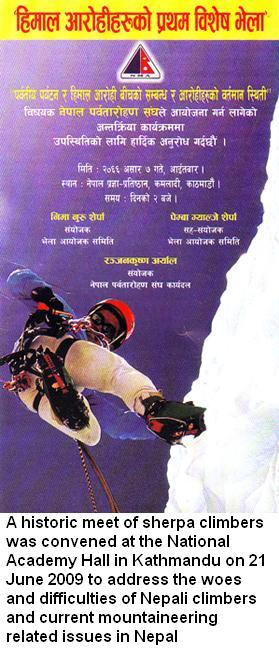
(MountEverest.net/Reported by Ang Karma Sherpa) A historic meet of Sherpa climbers was convened sherpa meetok Newat the National Academy Hall in Kathmandu on 21 June 2009 to address the woes and difficulties of Nepali climbers and current mountaineering related issues in Nepal.

This first ever meet of Nepali climbers in the history of Nepali mountaineering was organized by the task force committee formed by the government to steer the Nepal Mountaineering Association (NMA).

600 Nepali climbers

The meet was attended by 34 regional mountaineers clubs, mountaineering related association/agencies and approximately 600 Nepali climbers and 100 expedition operator representatives.

Over 30 speakers, majority of them comprised of Nepali climbers, spoke on various issues relating to the state of Nepali climbers, Himalayan environment and special provisions to be incorporated in the drafting of the new constitution to address concern of Nepali mountaineers.

“Nepali mountaineers have come of age to lead their own destiny”

In his welcome address, Nima Nuru Sherpa, member of the NMA task force committee & convener of the Meet highlighted the special role and contribution of Nepali climbers towards the development mountaineering activities in particular and tourism in general in Nepal.

He said, “We Sherpas of younger generation are indebted to our forefathers for their hard work and integrity for the glory they brought in the community and nationwide.”

He added, “Mountaineering trends and scenes have changed and our generation needs to be prepared to accept new challenges both on the mountains and policy making level to give new direction to mountaineering activities for the benefit of all. I believe Nepali mountaineers have come of age to lead their own destiny and this meet is to set the first milestone in this regard.”

Pemba Gyalje Sherpa, “does the state know the plight of Nepali climbers when they get old?”

Recipient of National Geographic award of “Adventurer of Year in Heroism in 2008″ the savior in the storm on K2, Pemba Gyalje Sherpa – co-convener of the meet – highlighted problems of the Sherpas in the following words, “Although small in numbers we have made a huge contribution to bring glory to the nation. It is time the Nepali state recognized the contribution made by us and this can be done by making special provision in the drafting of the new constitution.”

He added, “Does the state know the plight of Nepali climbers when they get old and can work for expeditions no more? Many of them have to walk bare feet, their children receive no quality education and when they get seriously injured in the mountains they get no prompt rescue and good treatment afterwards.”

Highlighting the issue further he added, “when they become old or permanently injured from accidents they are left to die on their own – not to mention their widows and children who have no one to support them…”

“Even renowned Nepali climbers are fleeing the country for employment elsewhere because of the state’s neglect. This is going to cost Nepal heavily in the long run, as it will create a void of experienced Nepali mountaineers for future expeditions.”

Pemba also expressed his concern that such a situation is emerging because the Nepal Mountaineering Association, founded to safe-guard the interest and welfare of Nepali mountaineers, has long been run by non-mountaineers.

Mountaineering related agencies to be restructured; guides to obtain international certificates

Nawang Nima Sherpa, member of Nepali Mountaineers’ Welfare & Rights Committee spoke about the need of restructuring mountaineering related agencies in order to recognize and evaluate full potentialities of Nepali climbers in tune with the changing times.

He also mentioned the government and concerned parties have neglected important issues relating to mountaineering and Nepali climbers such as:

- proper regulations to direct mountaineers conduct during expeditions,
- timely reform in the role of liaison officers,
- adequate insurance,
- prompt rescue and evacuation of Nepali climbers during accidents,
- pension and welfare of retired Nepali climbers.

In view of the changing mountaineering trends and scenario in the Himalaya mountains, he also spoke about further upgrading mountaineering skills of Nepali climbers and need for mountaineering schools to produce professional Nepali mountain guides with international diplomas.

Lhakpa, “foreign climbers talk more about their yaks than their Sherpas” – Junila, “parts of royalty fees should cover help to injured Sherpas and their relatives”

Lhakpa Phuti Sherpa, president of Nepal Women Mountaineering Association spoke about the decimation practiced by foreign climbers and mountaineering associations. Quoting from her experience of attending a mountain film festival in Switzerland, she said, “Foreign climbers talk tirelessly about our yaks but hardly mention a word about their expedition Sherpas – who is going to speak about this double standard?”

Usha Bista, Everest summiteer and member of the 2008 Nepal Women expedition to Everest said, “handing out certificates and medals to mountaineers is no longer enough; has the Nepali government done anything for Dharma Raj Rai, who helped Nepali climber and oldest Everest summiteer Min Bahadur Sherchan, 77, to reach Everest summit and lost fingers on both hands in the process?”

Junila Subba, another woman Everest summiteer from the same expedition spoke about the need of inclusion of Sherpa climbers in the policy making body of the government and launch welfare programs to support climbers and their family in such need from the money raised from expedition royalty fees.

Rescue resources, social security, climate change

President of TAAN, Jyoti Adhikari urged the government to make arrangement for education and health and special privileges in transportation and employment for Nepali mountaineers and their families. He also requested the government to take immediate initiatives in developing an effective mechanism for the rescue of mountaineers, both foreigners and Nepali, in case of accidents and selection of liaison officers from Nepali climbers. He demanded social security for climbers and their family after they retire.

Parliamentarian and Constituent Assembly members Ms. Shanta Chaudari and Pasang Sherpa pledged their support to have the interest and rights of Nepali mountaineers addressed in the drafting of new constitution.

They also spoke about the need to save Himalaya from climate change and revenues from mountaineering ploughed back for the betterment of mountain people.

Policies are enough; implementation is what matters

Former Secretary of Nepali Tourism Ministry Dipendra Purush Dhakal said, “Pressuring the government to make policies to address the woes and difficulties of Nepali climbers is a work of a special nature. Drafting policies and regulations alone is not enough; what is important is the implementation and execution part.”

Mr. Dhakal will help prepare a work paper on the meet to present to the government and other concerned agencies.

Ranjan Krishna Aryal, concluded the Meet with the following remarks: “I believe the issues raised in this Meet will affect the government to amend the current mountaineering rules and regulation for the overall benefit of mountaineering activities in our country. I as a legal person in the Ministry of Tourism will offer my best support in this regard.”

Ranjan Krishna Aryal, joint secretary at the Nepali’s tourism ministry and the convener of NMA task force chaired the meet with veteran Sherpa Ang Rita gracing the meet as the guest of honor.

Other prominent invitees included former secretary at the Ministry of Tourism Dipendra Purush Dhakla; parliamentarian and constituent assembly members Pasang Sherpa and Ms. Shanta Chaudary; former NMA president Tek Chandra Pokharel; Trekking Agent’s Association Nepal (TAAN) president Jyoti Adhikari and first Nepali teenager Everest summiteer Shambu Tamang.

Citing complaints of monopoly and irregularities from Nepali mountaineers and mountaineering professionals, last year, Nepal’s Ministry of Tourism directed the last elected committee of NMA to resign en masse and consequently a 5 member task force committee was formed in replacement.

However in defiance to the formation of task force by the government and in a rushed election a new NMA executive committee was elected. This committee has so far failed to receive approval from the Ministry of Tourism, hence forced to work in ‘exile’.

The Ministry of Tourism is the co-coordinating agency of NMA for government related matters. An attempt by the task force, with support from the majority of Nepali climbers, to elect a new executive committee is on hold due to legal/political wrangling.

Exweb Week-In-Review is sponsored by HumanEdgeTech the world’s premier supplier of expedition technology. Our team helps you find ultra light expedition tech that works globally.

e-mail or call +1 212 966 1928

* Read these stories – and more! – at ExplorersWeb.com

* zapraszam do subskrypcji mojego bloga :

AddThis Feed Button

** zapraszam na relacje z wypraw polskich himalaistów.

Safari to Chitwan Region Nepal 2009 - video.

Posted by himalman On 6/18/2009 11:03:00 am 0 comments
I would like to invite you to watch one of movie of Everest collection…

Safari to Chitwan Region Nepal 2009.

Trekking safari to Royal Chitwan National Park in Terai region, Nepal with Lincoln Widmer, Patricia Widmer, Mildred and Renato Poggetti in early 2009. Safari organized by Extreme Adventures in Kathmandu.


* Source : – http://www.youtube.com/

goryonline.com

* zapraszam do subskrypcji mojego bloga :

AddThis Feed Button

** zapraszam na relacje z wypraw polskich himalaistów.

Chitwan National Park.

Posted by himalman On 6/13/2009 10:54:00 am 1 comments
CHITWAN NATIONAL PARK -1973 ( Area 932 sq. Kms)

The park is situated in south central Nepal, covering 932 km2in the subtropical lowlands of the inner Terai. The area comprising the Tikauli forest-from Rapti river to the foothills of the Mahabharat-extending over an area of 175 km2 was declared Mahendra Mriga Kunj (Mahendra Deer Park) by the late King Mahendra in 1959. In 1963, the area south of Rapti River was demarcated as a rhinoceros sanctuary. The area was gazetted as the country's first national park in 1973, recognizing its unique ecosystems of international significance. UNESCO declared RCNP a World Heritage Site in 1984,In 1996 an area of 750 km2 surrounding the park was declared a buffer zone, which consists of forests and private lands including cultivated lands.

The park and the local people jointly initiate community development activities and manage natural resources in the buffer zone. His Majesty's Government has made provision of to provide 30-50 percent of the park revenue for community development and natural resource management in the buffer zone.

The park consists of a diversity of ecosystems-including the Churia hills, Ox-bow lakes, and the flood plains of the Rapti, Reu and Narayani Rivers. The Churia hills rise slowly towards the east from 150 m. to more than 800 m. The western portion of the park is comprised of the lower but more
rugged Someshwor hill. The park shares its eastern boundary with the Parsa Wildlife Reserve.

Climate.

The park has a range of climatic seasons each offering a unique experience. October through February with average temperatures of 25oc offer an enjoyable climate. From March to June temperatures can reach as high as 43oC, The hot humid days give way to the monsoon season that typically lasts from late June until September, Rivers become flooded and roads are impossible.

In late January, local villagers are allowed to cut thatch grasses to meet their needs, which offers a better viewing of wildlife to visitors. September ,November , February and April, migratory birds join the residential birds and create spectacular bird watching opportunities. While the monsoon rains bring lush vegetation, most trees flower in late winter. The palash tree, known as the "flame of the forest' and silk cotton tree have spectacular crimson flowers that can be seen from a distance.

Flora & Fauna.

The Chitwan valley consists of tropical and subtropical forests. Sal forests cover 70 percent of the park. Sal leaves are used locally for plates in festivals and religious offerings.

Grasslands cover 20 percent of the park. There are more than 50

different types of grasses, including the elephant grass (Saccharum spp ), renowned for its immense height. It can grow up to 8m in height. The park is home to more than 50 mammal species, over 525 birds, and 55 amphibians and reptiles. The endangered fauna found in the park are: One-horned rhinoceros, Gaur. Royal Bengal tiger. Wild elephant, Fourhorned antelope, Pangolin, Golden monitor lizard, Python, etc. Bengal florican. Lesser florican, Giant hornbill, Black stork, While stork, etc.

Facilities.

The display at the visitor centre at Sauraha provides fascinating information on wildlife and conservation program. The women's user groups' souvenir shop offers a variety of handicrafts and other local products for gifts and souvenirs.

Elephant safari provides opportunity to get a closer view of the endangered one-horned rhinoceros. One may also get a glimpse of the elusive Bengal tiger. The Elephant Breeding Center at Khorsor, Sauraha gives you information on captive elephant and the calves born there.

The museum at Kasara, the park headquarters, has informative displays- Near the HQ visitors can see Bikram Baba, a Hindu religious site of archival value. A short walk (1km) from the park HQ will take you to the Gharial Breeding Center, which is also home to the Marsh mugger and number of turtles.

Inside the park, there are 7 resorts run by park concessionaires that can provide lodging and access to wildlife activities. Various resorts and lodges situated outside the park also offer variety of services.

How to get there.

Public buses, tourist coaches, and airlines service link Chitwan. There are nine entrance gates to the park
1, Kasara via Jagatpur , 2. Ghatgain via Patihani , 3. Bhimle via Maghauli, 4. Khagendra mali via Bhandara , 5. Sunachuri via Sunachuri , 6. Sauraha via Tandi (Ratna Nagar)7. Laukhani via Pragatinaggr , 8. Amaltari via Danda , 9. Kujauli via Rajahar

* see : - SAGARMATHA NATIONAL PARK / Version polish and english /

- Safari to Chitwan Region Nepal 2009 - video.

- oryginal post by : – http://www.dnpwc.gov.np/national-parks-chitwan.asp

goryonline.com

* zapraszam do subskrypcji mojego bloga :

AddThis Feed Button

** zapraszam na relacje z wypraw polskich himalaistów.

Sociofluid

Promote cool website

Climbing courses and training - PZA Climbing Center in Tatras
One of best website about Mt Everest
www.Everest1953.co.uk
You can help

Trekking agency

advertise on blog

MY Favorite books...


    Polish Himalayas on Facebook

    Great tops for everyone!

    Mountaineering is my hobby and profession of walking, hiking, trekking and climbing up mountains. It is also sometimes known as alpinism, particularly in Europe.

    Picasa Web Albums

    Himalman's Weblog