Trekking Tours

Posted by Author On 5/29/2009

POST-SUMMARY-HERE

Everest, Everest History, Everest Firsts

Posted by Author On 5/29/2009

POST-SUMMARY-HERE

Expedition, expedition list, expeditions on 8000m peaks

Posted by Author On 5/29/2009

POST-SUMMARY-HERE

Showing posts with label kathmandu. Show all posts

Jun 26, 2009
(MountEverest.net/Reported by Ang Karma Sherpa) A historic meet of Sherpa climbers was convened sherpa meetok Newat the National Academy Hall in Kathmandu on 21 June 2009 to address the woes and difficulties of Nepali climbers and current mountaineering related issues in Nepal.
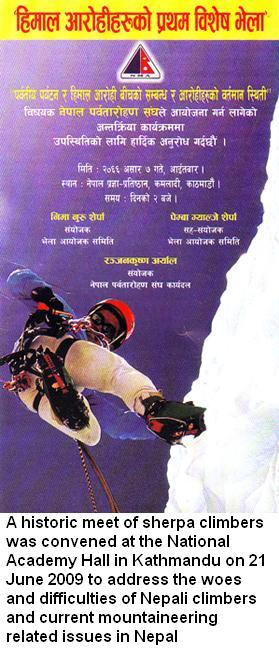
This first ever meet of Nepali climbers in the history of Nepali mountaineering was organized by the task force committee formed by the government to steer the Nepal Mountaineering Association (NMA).

600 Nepali climbers

The meet was attended by 34 regional mountaineers clubs, mountaineering related association/agencies and approximately 600 Nepali climbers and 100 expedition operator representatives.

Over 30 speakers, majority of them comprised of Nepali climbers, spoke on various issues relating to the state of Nepali climbers, Himalayan environment and special provisions to be incorporated in the drafting of the new constitution to address concern of Nepali mountaineers.

“Nepali mountaineers have come of age to lead their own destiny”

In his welcome address, Nima Nuru Sherpa, member of the NMA task force committee & convener of the Meet highlighted the special role and contribution of Nepali climbers towards the development mountaineering activities in particular and tourism in general in Nepal.

He said, “We Sherpas of younger generation are indebted to our forefathers for their hard work and integrity for the glory they brought in the community and nationwide.”

He added, “Mountaineering trends and scenes have changed and our generation needs to be prepared to accept new challenges both on the mountains and policy making level to give new direction to mountaineering activities for the benefit of all. I believe Nepali mountaineers have come of age to lead their own destiny and this meet is to set the first milestone in this regard.”

Pemba Gyalje Sherpa, “does the state know the plight of Nepali climbers when they get old?”

Recipient of National Geographic award of “Adventurer of Year in Heroism in 2008″ the savior in the storm on K2, Pemba Gyalje Sherpa – co-convener of the meet – highlighted problems of the Sherpas in the following words, “Although small in numbers we have made a huge contribution to bring glory to the nation. It is time the Nepali state recognized the contribution made by us and this can be done by making special provision in the drafting of the new constitution.”

He added, “Does the state know the plight of Nepali climbers when they get old and can work for expeditions no more? Many of them have to walk bare feet, their children receive no quality education and when they get seriously injured in the mountains they get no prompt rescue and good treatment afterwards.”

Highlighting the issue further he added, “when they become old or permanently injured from accidents they are left to die on their own – not to mention their widows and children who have no one to support them…”

“Even renowned Nepali climbers are fleeing the country for employment elsewhere because of the state’s neglect. This is going to cost Nepal heavily in the long run, as it will create a void of experienced Nepali mountaineers for future expeditions.”

Pemba also expressed his concern that such a situation is emerging because the Nepal Mountaineering Association, founded to safe-guard the interest and welfare of Nepali mountaineers, has long been run by non-mountaineers.

Mountaineering related agencies to be restructured; guides to obtain international certificates

Nawang Nima Sherpa, member of Nepali Mountaineers’ Welfare & Rights Committee spoke about the need of restructuring mountaineering related agencies in order to recognize and evaluate full potentialities of Nepali climbers in tune with the changing times.

He also mentioned the government and concerned parties have neglected important issues relating to mountaineering and Nepali climbers such as:

- proper regulations to direct mountaineers conduct during expeditions,
- timely reform in the role of liaison officers,
- adequate insurance,
- prompt rescue and evacuation of Nepali climbers during accidents,
- pension and welfare of retired Nepali climbers.

In view of the changing mountaineering trends and scenario in the Himalaya mountains, he also spoke about further upgrading mountaineering skills of Nepali climbers and need for mountaineering schools to produce professional Nepali mountain guides with international diplomas.

Lhakpa, “foreign climbers talk more about their yaks than their Sherpas” – Junila, “parts of royalty fees should cover help to injured Sherpas and their relatives”

Lhakpa Phuti Sherpa, president of Nepal Women Mountaineering Association spoke about the decimation practiced by foreign climbers and mountaineering associations. Quoting from her experience of attending a mountain film festival in Switzerland, she said, “Foreign climbers talk tirelessly about our yaks but hardly mention a word about their expedition Sherpas – who is going to speak about this double standard?”

Usha Bista, Everest summiteer and member of the 2008 Nepal Women expedition to Everest said, “handing out certificates and medals to mountaineers is no longer enough; has the Nepali government done anything for Dharma Raj Rai, who helped Nepali climber and oldest Everest summiteer Min Bahadur Sherchan, 77, to reach Everest summit and lost fingers on both hands in the process?”

Junila Subba, another woman Everest summiteer from the same expedition spoke about the need of inclusion of Sherpa climbers in the policy making body of the government and launch welfare programs to support climbers and their family in such need from the money raised from expedition royalty fees.

Rescue resources, social security, climate change

President of TAAN, Jyoti Adhikari urged the government to make arrangement for education and health and special privileges in transportation and employment for Nepali mountaineers and their families. He also requested the government to take immediate initiatives in developing an effective mechanism for the rescue of mountaineers, both foreigners and Nepali, in case of accidents and selection of liaison officers from Nepali climbers. He demanded social security for climbers and their family after they retire.

Parliamentarian and Constituent Assembly members Ms. Shanta Chaudari and Pasang Sherpa pledged their support to have the interest and rights of Nepali mountaineers addressed in the drafting of new constitution.

They also spoke about the need to save Himalaya from climate change and revenues from mountaineering ploughed back for the betterment of mountain people.

Policies are enough; implementation is what matters

Former Secretary of Nepali Tourism Ministry Dipendra Purush Dhakal said, “Pressuring the government to make policies to address the woes and difficulties of Nepali climbers is a work of a special nature. Drafting policies and regulations alone is not enough; what is important is the implementation and execution part.”

Mr. Dhakal will help prepare a work paper on the meet to present to the government and other concerned agencies.

Ranjan Krishna Aryal, concluded the Meet with the following remarks: “I believe the issues raised in this Meet will affect the government to amend the current mountaineering rules and regulation for the overall benefit of mountaineering activities in our country. I as a legal person in the Ministry of Tourism will offer my best support in this regard.”

Ranjan Krishna Aryal, joint secretary at the Nepali’s tourism ministry and the convener of NMA task force chaired the meet with veteran Sherpa Ang Rita gracing the meet as the guest of honor.

Other prominent invitees included former secretary at the Ministry of Tourism Dipendra Purush Dhakla; parliamentarian and constituent assembly members Pasang Sherpa and Ms. Shanta Chaudary; former NMA president Tek Chandra Pokharel; Trekking Agent’s Association Nepal (TAAN) president Jyoti Adhikari and first Nepali teenager Everest summiteer Shambu Tamang.

Citing complaints of monopoly and irregularities from Nepali mountaineers and mountaineering professionals, last year, Nepal’s Ministry of Tourism directed the last elected committee of NMA to resign en masse and consequently a 5 member task force committee was formed in replacement.

However in defiance to the formation of task force by the government and in a rushed election a new NMA executive committee was elected. This committee has so far failed to receive approval from the Ministry of Tourism, hence forced to work in ‘exile’.

The Ministry of Tourism is the co-coordinating agency of NMA for government related matters. An attempt by the task force, with support from the majority of Nepali climbers, to elect a new executive committee is on hold due to legal/political wrangling.

Exweb Week-In-Review is sponsored by HumanEdgeTech the world’s premier supplier of expedition technology. Our team helps you find ultra light expedition tech that works globally.

e-mail or call +1 212 966 1928

* Read these stories – and more! – at ExplorersWeb.com

* zapraszam do subskrypcji mojego bloga :

AddThis Feed Button

** zapraszam na relacje z wypraw polskich himalaistów.

Rafting in Nepal – Sun Koshi River Rafting.

Posted by himalman On 6/07/2009 10:54:00 am 0 comments

River Informtion.

We travel by surface to Dolalghat your raft ‘put-in-point’ covering the distance of 57kms in about 3 hrs. sunkoshi raftingYour excitement starts and ends only after you covered 210kms of wild stretches, calm flows through high rock strewn passages eventually emerging form the mountains to the flat plains of southern Nepal.

One of the 10th classic and best white water journeys on Sunkoshi (river of gold) is in Nepal offers a longest river trip and the most fascinating among the few rivers, which flow down from snow-capped mountains. Big rapes, warm water, beautiful scenery and great camping makes this is a classic multi-day river trip. There will be a great trip for intermediate and advanced kayakers. At its best in medium to high flows. This enchanting river expedition of 9 days will definitely be the highlight of you visit to Nepal, its memory shall last for ever and ever . Sunkoshi is an unpredictable river, it has its own moods, serene, calm and tranquil one moment, wile and turbulent the next, always changing, always challenging, the ultimate in the river adventure. So, Sun Koshi is famous in rafting circles, and with good reason.

With in a short span or 9 days, you come in close contact with Nepal’s natural beauty, people, culture, wildlife and its rivers, its simply magic, an experience you shall be glad you took. En route to the Chatara you come across many ethnic groups, each unique and colorful as relatively more Rais, Limbus and Newar are seen in this area. In this trip you have 250 different species of orchids to look for. River chats, dippers, flycatcher, wall creepers, bulbuls, fork tales are a few of the almost 400 species of birds available around the basin.

Sunkoshi WaterfallThere are few more tributary of Sun Koshi as Rosi Khola, Junga Khola, Tamakoshi (Copper River), Dudh Koshi (Milk River), Rasuwa Khola. Tribenighat from where the Arun and Tamur join the Sunkoshi to form the giant Saptakoshi, which flows through Mahabharat range onto the Gangetic plain.

There are numerous (abundant) rapids such as Meat Grinder, Punch, and High Anxiety etc. Scaled from 3-8 will eventually emerges into the low land of Terai at Chatara. After 45-minute drive from Chatara you arrive in Dharan, which use to be British Gurkha Army recruiting center in Nepal for decades. Now you have several options as you can Drive to Biratnagar and take a flight to Kathmandu or drive to Chitwan National Park or Koshi Tappu for an excellent safari trip or drive back to Kathmandu.

map_sunkoshi _600 New

Trip itinerary.

A pre-departure meeting to answer any questions, arrange timings for the departure and meet the team over a glass of rum (or two) is held the night before.

Day 1: 3hrs drive to Dolalghat; rafting starting point and short rafting camp in Tarang Gaon

Day 2: Tarang Gaon to Dumja village rafting approx. 4 hours The gathered villagers shall cheer you as you drift away slowly gathering momentum, slowly leaving behind the Langtang ranges. Sunkoshi is considered as a Holy river by the Nepalese Hindus, the river flows into the Holy Ganges in India, soon we hit the very technical rapid called Khuei Bhai rapid, strewn with rooks and boulders, hence, considerable care is need. Camp for the night near the Mahadev temple, reputed to be the first Shiva temple in Nepal.

Day 3: Dumja village to Khunkot rafting approx. 6 hours WET AND WILD.immediately we are hitting the rapids passing enroute the fishing village of Kodaris’ and the Chamera Bhir were you see hundreds of bats screaming and clinging to the walls of the cliffs, some good fun filled rapids takes up to Khunkot where we camp for the night.

Day 4: Khurkot to Likhu Khola rafting approx. 5 hours Habitations dwindle, few poor Rai villages’ enroute, exciting rapids in the afternoon with good photo prospects

Day 5: Likhu Khola to Harkapur village rafting approx. 6 hours Today, we pass through deep gorges punctuated with exciting rapids unfolding pleasant floats in the afternoon troops of Langur and Rhesus monkeys can be seen romping the riverbanks.

Day 6: Harkapur village to Rai Ghat rafting approx. 6 hours Today is one of the most exciting and challenging days of the expedition encountering some very demanding rapids where you witness the skills of our guides, we pass through ‘Bridge rapids’ and ‘Krishna rapids’ stopping to carefully plan our strategy through the next rapids. Mr. Mangal Gurung was the first rafter to successfully take rafts in 1979 and he has the distinction of being the 1st Nepali to raft the Sunkoshi, it was a no mean success, hence, the rapid is named after him ‘MANGAL RAPID’. Floating past the confluence of the Dudh Koshi, we hit the last rapid for the day, ‘Roller Coaster’ a hair rising rapid.

Day 7: Rai Ghat to Bander Ghat rafting approx. 6 hours Hold tight, the ride is not over yet.as past the point of Sap Su Khola is a rapid with the greatest drop Huge ‘holes’, ‘eddies’ and churning ’stopper waves’ demands team work and hard paddle.

Day 8: Bander Ghat to Bonjur Ghat rafting aprox. 6 hours We take to the rapids again, busy all morning earnestly thanking for the lunch break, emerging from the Mardheku gorge the river spreads wide, less agitated after its confinement between steep cliffs and gorges.

Day 9: Bonjur Ghat to Barahchhatra rafting aprox. 6 hours Today the whole stretch is a mixture of fun filled rapids and calm undulating floats, you are somewhat relived, yet sad that the trip is coming to an end, all good things ultimately does.

Day 10: Short rafting reaches out points Chatara, after lunch takes night bus to Kathmandu or drive to Biratnagar to take a flight back to Kathmandu.
After a while we join the turbid waters of the Arun Koshi encountering our last rapids to the junction of the Tamur Koshi. The river changes its course from west -east to northeast through beautiful gorge floating to the white temple of Barahchhatra set upon the east bank. This is a Hindu temple dedicated to 12 different Hindu Gods and Goddesses; we stop to pay a visit. Suddenly we break through the Mahabharat and Rapcha ranges and spreading before us is a completely flat horizon, slowly we drift to Chatara. After Chatara we drive to Koshi Tappu or Chitwan National Park for an excellent Safari or drive back to Kathmandu or drive to Biratnagar for your fly back to Kathmandu.

* Source : – http://www.nepalraft.com/rivers/sunkoshi.php

- oryginal post by : - http://himalman.wordpress.com/

goryonline.com

* zapraszam do subskrypcji mojego bloga :

AddThis Feed Button

** zapraszam na relacje z wypraw polskich himalaistów.

Fantastic world level rafting in Nepali Rivers.

Posted by himalman On 6/05/2009 06:19:00 am 2 comments

Nepal is country of mountains and it has plenty of mountain rivers. So rafting is very popular in Nepal rivers. There are many rivers in Nepal for rafting but the Sunkoshi, the Trishuli and the Kaligandaki are major ones. Sunkishi river was rated as the world’s top 10 rafting rivers by Adventure Travel Magazine.

Rafting is highly dependent on season and monsoon is the worst time for rafting as conditions are damp, trails are muddy and rivers are often too high. From October, when the monsoon ends, the conditions are perfect. The weather is superb,the scenery is green. Spring is best season for rafting as the weather is warmer and the melting snow means fast- flowing water.

There are many rafting companies in Kathmandu. They will offer you all needs and you don’t need any preparations if you like to go for rafting. The operator will costs you from $25 -$75+ a day and one trip generally takes 3 to 9 days. Below is introduction to rafting rivers in Nepal.

Trishuli River

Probably it is the most popular river in Nepal.this river starts north-west of Kathmandu and flows south and then south-west of Marsyangdi River. it then follows south to the Terai.

This is even good for inexperienced persons bacause it is gentle one. it will take 3-7 days a trip in trishuli River.

Sunkoshi river

The Sunkoshi flows southward from the himalaya and then turns west and flows right across Nepal. The Sunkoshi ans the river which join into it flow down from some of the highest mountains of the Homalaya. Rafting trip goes through a variety of country, includin widw valleys and deep gorges, and past small villages where dugout canoes are used as transport across the river. From the mountain pines forests in the high country you evenually emerge in the green and fertile lowlands of Terai.

Kaligandaki River

The Kaligandaki river, flowing south between Annapurna and Dhaulagiri and then turning west to the Narayani just north of Narayanghat, is not used as much as the Trishuli and Sunkoshi River.

Nepal – map rafting rivers :

I would like to invite you to watch absolutely amazing movie :

Highlights of trip from Kathmandu to Lhasa : Nepal & Tibet – amazing movie.

* Source : - http://himalman.wordpress.com/

goryonline.com

* * zapraszam do subskrypcji mojego bloga :

AddThis Feed Button

** zapraszam na relacje z wypraw polskich himalaistów.

Exploring Kathmandu – Nepal, new video.

Posted by himalman On 5/11/2009 02:46:00 pm 0 comments

I would like to invite you to watch one of movie of Everest collection…

Exploring Kathmandu – Nepal, new video on You Tube.

Video and photos of visit to Kathmandu – Nepal during March/April 2009. We enjoyed the ancient religious and cultural capital city of Nepal with family and friends from Brazil. The gentle Hindu and Buddhist people of this beautiful country coexist peacefully. We noticed a heavy presence of government and Maoist troops as the country continues UN brokered peace negociations.


* Source : – http://www.youtube.com/

* zapraszam na relacje z wypraw polskich himalaistów.

Himalaya wrap-up: over on Dhaulagiri.

“Two Peters” Hamor & Morawski for a Dhaula + Manaslu double header .

logo-dhaul_manaslu

morawski-new Dhaulagiri/Manaslu Expedition 2009 led by Piotr Morawski, the team : Peter Hamor and Piotr Morawski.

Polish climber Piotr Morawski and Slovak Peter Hamor aim for a new route on Manaslu’s west face. Then the climbers will move to Dhaulagiri, hoping to reach the summit via the Japanese route.

Dhaulagiri/Manaslu Expedition 2009 - in review :

2009, April 08

(MountEverest.net/K2Climb.net) It’s over on Dhaulagiri.pmorawskiplace-new

(Story updated 7:05 am CDT) Polish ace climber Piotr Morawski has perished on Dhaulagiri, local media have just reported.

The accident occurred today at 8.40am, local time. Piotr was reportedly on his way back from C2 when he fell in a crevasse at 5,500 meters (below C1).

The world climbing community has lost yet another of its rising stars: this morning Polish Piotr Morawski - one of the great “Two Peters” - perished in a crevasse on Dhaulagiri.

Piotr Morawski lost on Dhaulagiri: further details

The worst possible news broke earlier today from Dhaulagiri: At 8.40 am local time this morning, Polish Piotr Morawski fell to his death in a crevasse while returning from C2. At only 33, Piotr had summited six 8000ers, and made the first winter summit on Shisha Pangma (together with Simone Moro in January, 2005).
Part of Piotr Pustelnik’s Himalayan Trilogy team and teaming up with regular mate Peter Hamor; Piotr Morawski was climbing Dhaulagiri as a preparatory ascent before attempting to open a new route on Manaslu’s west face. Read more in a previous story published earlier today on Mounteverest.net.

Ryszard Gajewski, member in the Tatra’s Rescuers Association team (also attempting Dhaulagiri) reported further details on Piotr’s accident from BC:

Morawski fell in a 20 meter-deep crevasse at 5,760m - just 80 meters below C1. He was on his way down from C2, together with Slovak Peter Hamor and Justyna Szczepieniec.

As the accident took place at 8.40am, local time, a group of fellow Polish climbers - Mazik (expedition Doctor), Pawlikowski and Witkowski - belonging to the Tatra Rescuers Association was on their way to C1. Together with Hamor, they got Morawski out of the crevasse, after which Dr. Mazik could only confirm Piotr’s death.

* Source : - http://himalman.wordpress.com/ - MountEverest.net/K2Climb.net - http://pza.org.pl/ - http://www.piotrmorawski.com/

Wyprawa Hamor & Morawski - Dhaulagiri/Manaslu 2009.

Tragiczny koniec wyprawy:

08.04.2009 r.

Według pierwszych informacji himalaista, który brał udział w wyprawie międzynarodowej wyprawie Dhaulagiri/Manaslu 2009, spadł w 200-metrową szczelinę. Wypadek miał miejsce podczas wyjścia aklimatyzacyjnego (przygotowującego organizm do przebywania do wysokości) na wysokości ok. 5500 metrów - powiedział portalowi Gazeta.pl Marcin Józefowicz, z zakopiańskiego TOPR-u.

Akcja ratunkowa, przeprowadzona przez biorącą udział w równoległej wyprawie grupę TOPR, zakończyła się niepowodzeniem. Mimo to należy złożyć podziękowania dla ratowników za niesiona przez nich pomoc.

piotr_morawski-miejsce-wypadku-01

Prawdopodobne miejsce wypadku

zginal_piotr_morawski-miejsce-wypadku-02

Prawdopodobne miejsce wypadku z bliska

* Całe sprawozdanie z wypadku :

- Piotr Morawski zginął na Dhaulagiri - sprawozdanie z wypadku. POMÓŻMY RODZINIE PIOTRA.

POMÓŻMY RODZINIE PIOTRA

Po śmierci Piotra Jego Rodzina znalazła się w trudnej pod każdym względem sytuacji.

Jako koledzy i koleżanki z KW Warszawa mozemy i powinnismy pomóc.

Pieniązki mozna przekazywać na dwa sposoby:

1. Wpłaty na konto fundacji Kukuczki podając jako cel: “PIOTR MORAWSKI”.

2. Ponadto można przeznaczyć 1% podatku w ramach rozliczeń za 2008 rok na: akcję “Fundusz Berbeki - Piotr Morawski”

Konto:
Fundacja Wspierania Alpinizmu Polskiego im. Jerzego Kukuczki
00-666 Warszawa, ul. Noakowskiego 10 m. 12
konto: 04 1160 2202 0000 0000 5515 5611.

[komunikat dodał : Marcin Miotk na stronie - http://www.kw.warszawa.pl/ ]

* źródła : - http://pza.org.pl/ - http://www.piotrmorawski.com/

- Polish Himalaya Expeditions 2009 part 1. Himalaje 2009 - polskie wyprawy, cz. 1. /Version english and polish/

goryonline.com

gieldaturystyki.pl

** zapraszam na relacje z wypraw polskich himalaistów.

The ultimate challenge to the ‘just-do-it’ ambitious trekker. This moderate to challenging graded trek takes to you to the foot of Mt. Everest traversing across the high Cho La pass at an elevation of 5420 m. Also included is the opportunity to trek to the summit of both Gokyo Ri [5340m.] and Kala Pattar [5554m.] for magnificent views of Everest, Lhotse, Nuptse, Makalu and Cho Oyu.

A visit to Everest Base Camp will give you the chance to have a closer look at the spectacular Khumbu Icefall.

Beginners or inexperienced climbers can take this trek, but this trek requires one to be moderately fit.

Considering the snow conditions over Cho La Pass, the trek may not be advisable during winter [January & February] and the monsoon season [July & August].

Outline Itinerery :

Day 1 Arrive Kathmandu
Day 2 Sightseeing in Kathmandu
Day 3 Flight to Lukla & trek to Phakding (2656m)
Day 4 Trek to Namche (3450m)
Day 5 Rest day in Namche
Day 6 Trek to Dole (4084m)
Day 7 Trek to Machermo (4410m)
Day 8 Rest day in Machermo
Day 9 Trek to (4750m)
Day 10 Ascent of Gokyo Ri (5483m)
Day 11 Trek to Tragnag (4690m)
Day 12 Across Cho La 5420 m. to Lobuche (4928m)
Day 13 Trek to Gorak Shep (5184m)
Day 14 Trek to Everest Base Camp (5357m) & return to Gorak Shep
Day 15 Trek to Pangboche (3985m)
Day 16 Trek to Namche(3450m);
Day 17 Trek to Lukla (2800m)
Day 18 Fly to Kathmandu
Day 19 Depart Kathmandu

Detail Itinerery - Gokyo, Kala Pattar & Everest Base Camp Trek

DAY 01 ARRIVAL IN KATHMANDU
Flying to Kathmandu along the northern border of Nepal on a clear day is in itself an exciting and memorable experience as exotic panoramic view of snow-capped Annapurna mountain range peaks sprawls before you. The Nepali support team will meet you at the airport and escort you to your hotel.

Day 2 - Sightseeing of Kathmandu Valley
Kathmandu, being a historical and cultural heart of Nepal, is a popular destination for tourists, trekkers and adventure seekers. The city presents a wonderful mixture of Hinduism, Tibetan Buddhism and Western influence in the Valley. Patan and Bhaktapur are its two major neighboring cities which bear immense historical, cultural and religious significance. There will be a half day guided tour to the famous & biggest Hindu shrine Pasupathinath, the largest Buddhist stupa in town Boudhanath, the 15th century palace of 55 windows and Soyambhunath. In the evening, a trip orientation meeting will be organized.

Day 3 - Fly to Lukla & Trek to Phakding [2652m]
A spectacular flight and hair raising landing on a steep mountain runway brings us to the start of our trek at the village of Lukla [2850m]. After meeting the crew, we head up the Dudh Kosi Valley on a well-marked trail to Phakding.

Day 4 - Trek to Namche [3450m]
From Phakding, we cross and re-cross the river on high suspension bridges. Beyond Monjo is the entrance to the Sagarmatha National Park which was set-up in order to protect and preserve this fragile mountain environment. We then ascend quite steeply to Namche and along the way, if the weather is clear, catch a first glimpse of Mt Everest in the distance. Namche is the main trading village in the Khumbu and has a busy Saturday market - a meeting place for the Hindu traders from the lowlands and the Tibetan yak caravans that have crossed the glaciated Nangpa La Pass.

Day 5 - Rest day in Namche
Namche is tucked away between two ridges amidst the giant peaks of the Khumbu and has an abundance of lodges, tea shops and souvenir shops as well as a magnificent outlook. It is an ideal place to spend a rest day, acclimatizing to the new altitude before heading off towards Tengboche. Options for acclimatization walks include a visit to Khunde hospital which was set-up by Sir Edmund Hillary, or a one hour walk up to the Everest view hotel above Namche for the sunset view of Ama Dablam, Nuptse, Lhotse and Everest. There are also good views from the national park centre and museum just above the town.

Day 6 Trek to Dole [4084m]
We are now approaching 4500m, so we will stay at Machermo for an extra day .Today is a spectacular day in terms of scenery as we follow the main trail north out of Namche. A short climb to a crest reveals a wonderful view towards Everest and Lhotse. We follow this main trail for a while longer, passing many traders selling Tibetan handicrafts, to a crossroads high above the Dudh Kosi. The trail to Everest drops down the hill but we turn off here and climb to cross the Mon La before reaching Phortse Tenga. From Phortse Tenga, the trail climbs steeply to Dole, through rhododendron and birch forest festooned with hanging mosses and lichens.

Day 7 Trek to Machermo [4410m]
From Dole we climb steadily along the side of the valley, where the rhododendron forests give way to scrub juniper as the altitude increases. The trail passes many summer settlements [yersa], which are used when yaks are taken to these pastures to graze in the summer months. Ahead of us are excellent views of Cho Oyu, while at the rear are the peaks of Kantega and Thamserku. Today’s trek is a short one and we will arrive at Machermo in time for lunch.

Day 8 Rest day in Machermo
We are now approaching 4500m, so we will stay at Machermo for an extra day to acclimatise. There are plenty of possibilities for exploration around the camp and just above the village there is an excellent view encompassing Cho Oyu [8210m] and the mountains which flank the Ngozumpa Glacier.

Day 9 Trek to Gokyo [4750m]
Rested, we head for the lakes at Gokyo. We follow a very scenic path to Pangka and then descend slightly, following one of the rivers which flow down the west side of the Ngozumpa Glacier. We climb a steep rocky incline into the valley by the side of the glacier, passing the first of the holy lakes. We soon arrive at the second of the lakes, crossing the path which heads across the glacier to Cho La - our route to Lobuche and Everest, later in the trek. The third lake is known as Dudh Pokhari and on its eastern shore is the settlement of Gokyo. Walking by the side of the lake, the scenery is breathtaking with the summits of Cho Oyu and Gyachung Kang reflected in its emerald green waters.

Day 10 Rest day - Ascent of Gokyo Ri [5483m]
Gokyo Ri looms above the village on the northern edge of the lake and we leave camp just after first light, following a steep path up the hillside. As we climb, the summits of Everest, Lhotse and Makalu slowly come into sight and the view from the summit of Gokyo Ri itself, is one of the finest to be had in the Everest region - some say it is even better than that from Kala Pattar. For those who still have some energy, there are more good views to be had by dropping back down to the main path and following it north to the fourth and fifth of the Gokyo lakes, the latter being about three hours from Gokyo

Day 11 Trek to Tragnag [4690m]
Fit and acclimatised, we leave Gokyo to cross the Ngozumpa Glacier. We descend to the second lake and drop down onto the glacier. The route across the glacier is marked by cairns and is generally quite well defined. We climb off the glacier by a small dwelling known as Tragnag and follow a shallow valley to our camp by a small kharka.

Day 12 Trek to Lobuche [4928m]
An early start is necessary today, as we have to cross Cho La and make the long descent to Lobuche. Continuing up the valley, we cross a ridge and an old lateral moraine, before beginning the rocky scramble to the pass. From the pass there are excellent views, across to the Rolwaling Valley in the west and Ama Dablam to the south east. The descent from the pass involves the crossing of a small glacier [often snow covered] which is fairly straightforward.

There are more excellent views of Ama Dablam and the forbidding north face of Cholatse as we descend to the pastures below. The way to Lobuche contours the grassy slopes above a lake, the Tshola Tsho, to join up with the main Everest trail from Pheriche and Thyangboche. The trail flattens out and follows the valley on the west side of the Khumbu Glacier to Lobuche.

Day 13 Trek to Gorak Shep [5184m]
To reach our next objective, Kala Pattar, the trail continues to follow the valley beside the Khumbu Glacier, and offers superb views of the surrounding mountains, especially where the path is forced to rise to cross a tributary glacier. We stop for lunch at our camping place for the night, Gorak Shep. Later in the afternoon, when the sun begins to set over the Everest, we make our way to the top of one of the finest viewpoints in the Khumbu, Kala Pattar [5549m]. As the light begins to fade we stroll back to our camp at Gorak Shep and have an early night in preparation for our trek to Everest Base Camp the following day.

Day 14 Trek to Everest Base Camp [5357m] & return to Gorak Shep.
For the trek to Everest Base Camp, a very early start is required. It takes several hours on a trail across the Khumbu Glacier which weaves its way along translucent ice pinnacles and past seemingly bottomless crevasses. At Base Camp, there will hopefully be an expedition ‘in residence’ and there are great views up into the Khumbu Icefall where there is often some climbing activity. On the return leg, we can take a higher route to get a spectacular view of the Khumbu icefall and the route to the south Col. We then return to Gorak Shep.

Day 15 Trek to Pangboche [3985m]
It is downhill most of the way today, past Lobuche to Duglha and Pheriche. The Himalayan Rescue Association has trekkers’ aid post here which is interesting to visit. After lunch we cross the Khumbu Khola on a wooden suspension bridge and follow the Imja Khola to the village of Pangboche.

Day 16 Trek to Namche [3450m]
We continue to follow the river and, after crossing it, climb up through birch and rhododendron forest to Thyangboche and its famous monastery. There are magnificent views from here and Kwangde, Tawache, Everest, Nuptse, Lhotse, Ama Dablam, Kantega and Thamserku are just a few of the Himalayan giants which can be seen. From Thyangboche we descend to the bridge over the Dudh Kosi at Phunki Tenga, where there are water driven prayer wheels, before making our way back to Namche.

Day 17 Trek to Lukla [2800m]
Our final day’s trekking follows the Dudh Kosi back down to Lukla. This last evening in the mountains is the ideal opportunity for a farewell party with the sherpa guides and porters, where we can sample some chang, try Sherpa dancing and look back on a memorable trekking experience.

Day 18 Fly to Kathmandu
We take an early morning flight back to Kathmandu.

Day 19 Depart Kathmandu
Our Nepalese support team will take you to the airport for your flight home.If you prefer to stay longer, you can go for short tours such as game drive at National parks, rafting, Tibet tours, mountain biking etc).

Nepal & Tibet - amazing movie. /Version polish and english/

Posted by himalman On 11/22/2007 11:01:00 am 2 comments
I would like to invite you to watch absolutely amazing movie :
Highlights of trip from Kathmandu to Lhasa.


Kathmandu (Nepali: काठमाडौं, काठमान्डु, Nepal Bhasa: येँ) is the capital and the largest city of Nepal. The city is situated in Kathmandu Valley that also contains two other cities - Patan and Bhaktapur. The original inhabitants of Kathmandu are called Newars, who speak a language called Nepal Bhasa. However, Nepali is the lingua franca of the valley and is the most widely spoken language. The city stands at an elevation of approximately 1,300 m and is inhabited by around 3 million people though it is to be officially verified. The official estimate of the population is of 0.8 million. Kathmandu is located at 27°23′N, 85°22′E. It is one of the most developed cities in Nepal.

Lhasa, sometimes spelled Lasa, is the traditional capital of Tibet and the capital of the Tibet Autonomous Region of the People's Republic of China. Lhasa is located at the foot of Mount Gephel.
The city is the traditional seat of the Dalai Lama and the Potala and Norbulingka palaces and in Tibetan Buddhism is regarded as the holiest centre in Tibet.
The city is home to about 255,000 inhabitants and, at an altitude of approximately 3,650 m (11,975 ft), is one of the highest cities in the world.
Lhasa literally means "place of the gods", although ancient Tibetan documents and inscriptions demonstrate that the place was called Rasa, which means "goat's place", until the early 7th century.
The city is part of a township-level prefecture, the Lhasa Prefecture consisting of 7 small counties: Lhünzhub County, Damxung County, Nyêmo County, Qüxü County, Doilungdêqên County, Dagzê County,Maizhokunggar County.

Katmandu (nep. काठमाडौं trl. Kā􀃓hmā¨􀂟ū, trb. Kathmandu) - stolica Nepalu - miasto położone w środkowej części kraju, w dolinie o tej samej nazwie.
Wraz z miastami Patan, Bhatgaun tworzy aglomerację liczącą powyżej miliona mieszkańców.

Przemysł włókienniczy, spożywczy, drzewny, materiałów budowlanych i obuwniczy. Międzynarodowy port lotniczy. Uniwersytet.
Połączenie drogowe z Birgańdź (na granicy z Indiami) i Kodari (przy granicy z Chinami); koleją linową z Hetauri.
Stare miasto znane jest z buddyjskich świątyń i pałaców, które w większości pochodzą z XVII wieku. Wiele z obiektów jest uszkodzonych przez trzęsienia ziemi oraz zanieczyszczenie środowiska. W dolinie Katmandu znajduje się siedem obiektów zamieszczonych na Liście światowego dziedzictwa UNESCO.

Lhasa (tyb.ས་ lha-sa; chiń. trad. 拉薩, uproszcz. 拉萨, pinyin.: Lāsà) – miasto w zachodnich Chinach, stolica Tybetańskiego Regionu Autonomicznego. Około 120 000 mieszkańców (2004; w 1992 roku 107 000 osób), zamieszkana głównie przez Tybetańczyków i Chińczyków Han.
Główny ośrodek gospodarczy regionu. Przemysł drzewny, skórzany, metalowy, włókienniczy, spożywczy i maszynowy. Elektrownia geotermiczna. Giełda połączona satelitarnie z giełdami w Szanghaju i Shenzhen. Węzeł drogowy; lotnisko.

Himalayan Pilgrimage - amazing movie.

Posted by himalman On 11/15/2007 10:22:00 am 0 comments
I would like to invite you to watch absolutely amazing movie....
Asia is home to the Himalayas, the highest mountain range on earth. Covering a distance of 2,700 kilometers, the Himalayas overlook the landscapes of six Countries: India, Nepal, Pakistan, China, Bhutan and Tibet. For thousands of years the people of these regions have considered the Himalayas to be a manifestation of divinity. Towering above all else on earth, the Himalayas reach out to touch the heavens. Himalayan Pilgrimage takes us through the Gandaki Valley - a place frozen in time. The Pilgrimage begins in Kathmandu the capital city of Nepal, then moves on to Pokhara, then Jomsom and finally to the sacred shrine of Muktinatha.


AddThis Feed Button

Discovering of Everest - Odkrywanie Everestu. / Sherpa people.

Posted by himalman On 10/24/2007 05:46:00 pm 3 comments
I would like to invite you on viewing of new photo gallery which pictures the story of the discovery and climbing the Mt Everest ..
Zapraszam na pokaz zdjęć z odkrywania i zdobywania Everestu :


Sherpa people

The Sherpa are an ethnic group from the most mountainous region of Nepal, high in the Himalaya. In Tibetan shar means East; pa is a suffix meaning 'people': hence the word sharpa or Sherpa. Sherpas migrated from eastern Tibet to Nepal within the last 500 years. A female sherpa is known as a "sherpani".

The term 'sherpa' (the preferred spelling with a lower case first letter) is also used to refer to local people, typically men, employed as porters or guides for mountaineering expeditions in the Himalayas. They are highly regarded as elite mountaineers and experts in their local terrain, as well as having good physical endurance and resilience to high altitude conditions. However, a sherpa is not necessarily a member of the Sherpa ethnic group.

Native territory

Most Sherpas live in the eastern regions of Nepal Solu, Khumbu or Pharak. However, some live farther west in the Rolwaling valley and in the Helambu region north of Kathmandu. Pangboche is the Sherpas' oldest village in Nepal, and is estimated to have been built over 300 years ago. Sherpas speak their own Sherpa language which in many ways resembles a dialect of Tibetan. They traditionally are traders and farmers, cultivating their high altitude fields of potatoes, barley, wheat and buckwheat. Some live near Namche Bazaar. The Jirels, native people of Jiri, are ethnically related to the Sherpas. It is said that the Jirels are descendants of a Sherpa mother and Sunuwar (another ethnic group of the eastern part of Nepal) father. In India, Sherpas also inhabit the towns of Darjeeling and Kalimpong and the Indian state of Sikkim. The 2001 Nepal Census recorded 154,622 Sherpas in that country, of which 92.83% were Buddhists, 6.26% were Hindus, 0.63% were Christians and 0.20% were Bön.

Famous Sherpas

The most famous Sherpa is Tenzing Norgay, who climbed Mount Everest with Edmund Hillary for the first time in 1953.

Two Sherpas, Pemba Dorjie and Lhakpa Gelu, have recently competed as to who can climb Everest from Basecamp the fastest. On May 23. 2003 Dorjie summitted in 12 hours and 46 minutes. Three days later, Gelu beat his record by two hours, summitting in 10 hours 46 minutes. On May. 21 2004 Dorjie again improved the record by more than two hours with a total time of 8 hours and 10 minutes.

On May 16 2007 Appa Sherpa successfully climbed Mt. Everest for the 17th time, breaking his own record for most successful ascents.

Sociofluid

Promote cool website

Climbing courses and training - PZA Climbing Center in Tatras
One of best website about Mt Everest
www.Everest1953.co.uk
You can help

Trekking agency

advertise on blog

MY Favorite books...


    Polish Himalayas on Facebook

    Great tops for everyone!

    Mountaineering is my hobby and profession of walking, hiking, trekking and climbing up mountains. It is also sometimes known as alpinism, particularly in Europe.

    Picasa Web Albums

    Himalman's Weblog